
Jobs for People Who Like Working With Their Hands (Ranked by 2035 Growth)
16 hands-on careers ranked by projected growth through 2035, from solar installers (+36.5%) to electricians (+9.2%), with median pay and how to get in. 14 of the 16 need no 4-year degree.
Founder of Ikigai · Career data + personality science
Some people think best while holding a wrench. Or a paintbrush, or an ultrasound probe, or the steering end of a very large machine. If an afternoon at a desk leaves you feeling like a houseplant nobody has watered, this list is for you.
Hands-on work gets talked about like a plan B. The numbers do not back that up. The U.S. Bureau of Labor Statistics projects total employment will grow 3.5% from 2025 to 2035. Among the 318 hands-on careers in our database with at least 10,000 U.S. jobs, 144 are projected to grow faster than that.
Fair warning: that is 45%, a little under the 51% for all careers of that size. Hands-on work is not a magic category. It has fast risers and slow fades, just like desk work does, which is exactly why a ranked list beats a vague pep talk about "the trades."
How we built this list
We started with all 952 careers in our data and kept the ones where "Realistic" (building, fixing, operating, working with tools, machines, animals or the outdoors) is the top interest type in the U.S. Department of Labor's O*NET data. Then we required at least 10,000 U.S. jobs, median pay of at least $50,000, and projected growth above 9%. We left out engineers, who score Realistic but mostly work at a screen.
Sixteen careers survived. Fourteen of them have no 4-year degree in the typical path.
Energy: where the top of the list lives
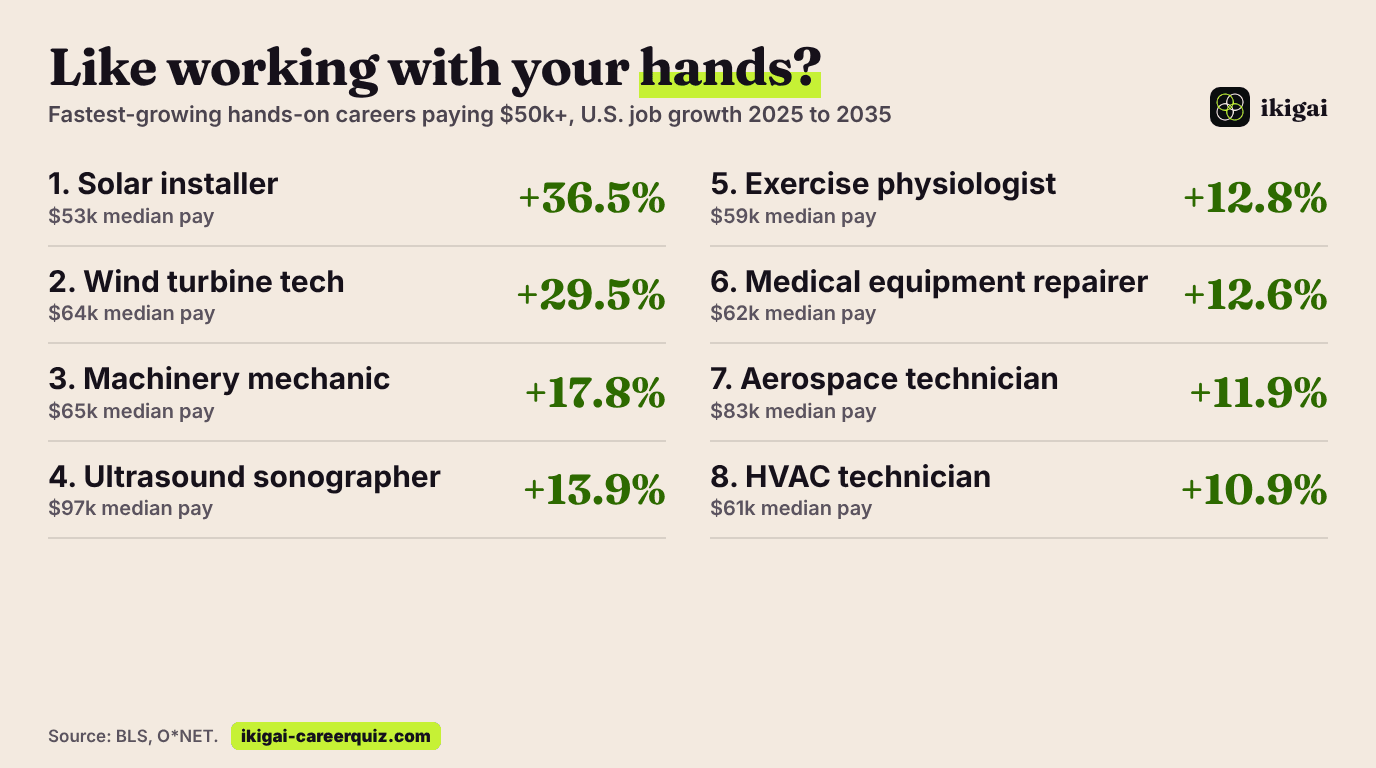
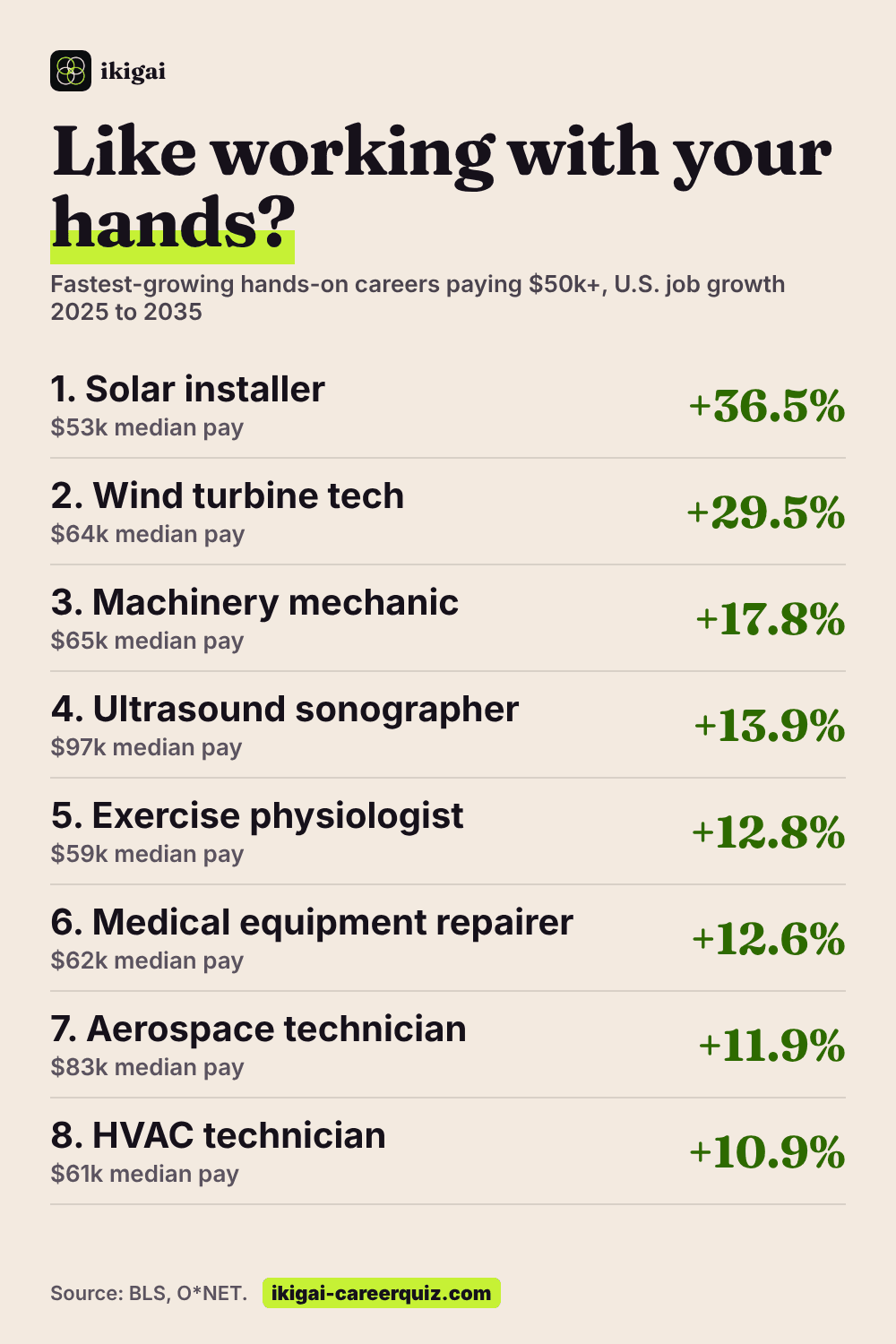
Solar installers (+36.5%) and wind turbine technicians (+29.5%) lead the whole ranking. Two caveats before you buy the tool belt. Both are small fields, about 31,100 and 11,800 jobs, so big percentages mean smaller headcounts. And energy policy can swing these numbers faster than most career projections.
The less glamorous grid jobs deserve a look too. Power-line installers (+10.3%) earn a median of $95,320, and powerhouse and substation repairers (+9.7%) earn $103,020. Everything that plugs in depends on them, including the thing you are reading this on.
Fixing the machines everyone else depends on
The sleeper hit here is industrial machinery mechanics: +17.8% on a base of about 446,900 jobs. That is the combination to look for, real growth in a field big enough to hire in most regions. When a factory line stops, this person is suddenly the most popular employee in the building.
Same energy, different machines: HVAC mechanics (+10.9%), farm equipment mechanics (+10.7%) and RV technicians (+9.7%). If you like aircraft, avionics technicians (+9.4%, $82,280 median) work on the electronics that keep planes talking to the ground.
Save the chart
The top 8 hands-on careers by projected growth, with median pay. Pin it for the friend who takes apart everything they own.
Save to PinterestHealth care, but with equipment
Hands-on does not have to mean outdoors or greasy. Sonographers (+13.9%) earn a median of $96,590, typically after a 2-year degree, which makes them one of the best pay-for-training deals on this list. Medical equipment repairers (+12.6%) keep hospital machines running and rarely appear on anybody's "dream job" poster, which may be part of the appeal. Exercise physiologists (+12.8%) and veterinarians (+9.4%, $130,100) are the two that take a college degree or more. Hands-on and highly educated are not opposites.
Building things you can point at
Electricians (+9.2%, about 821,000 jobs) are the anchor of the skilled trades, usually trained through a paid apprenticeship. Tile and stone setters (+9.8%) leave work that is still visible decades later, which is more than most spreadsheets can say.
The demand behind these jobs is partly about who is leaving. Associated Builders and Contractors, an industry group, estimates construction needs to attract 349,000 net new workers in 2026 and 456,000 in 2027, and its chief economist says most of 2026's demand comes from retirements. That is a trade group's model, so read it as a signal rather than a guarantee. BLS, for its part, projects construction and extraction jobs to grow 5.1% through 2035, above the all-jobs rate.
Just missed the cut, and the honest fine print
Our 9% line is arbitrary, and some excellent careers landed under it: MRI technologists (+7.7%, $95,480), plumbers (+6.8%, $63,800), aircraft mechanics (+5.4%, $79,870) and elevator installers (+5.7%, $109,910). Growth is only one question, and a large trade with lots of retirements can hire plenty of people at a modest growth rate.
Growth also does not equal pay. Ophthalmic medical technicians are growing 21.4% with a median of $45,570. Animal caretakers are at +12.1% and $35,360. Those missed our pay floor, not our respect, and they can be solid starting points on the way to something else.
And yes, hands-on work can be hard on your body. Before you commit, it is worth asking people who have done a job for 20 years what their knees think about it.
Where to go next
If pay is your main question, skilled trades that pay well and trade careers making six figures dig in. If you want to start soon, see jobs you can start at 18.
One caveat that applies to everything here: BLS looks about 10 years ahead. If you will start working after 2035, treat these as tailwinds worth exploring, not promises.
Find the hands-on career that fits you
"I like working with my hands" covers everything from wiring a substation to scanning a heartbeat. Our quiz takes about 7 minutes and narrows it down: it finds your interest mix, how hands-on you like your work and what you value, then ranks all 952 careers by how well they fit you and how fast they are projected to grow by the year you start working.
Take the quiz and see which hands-on careers are rising for you.
Sources: Interest profiles (RIASEC scores) from O*NET, U.S. Department of Labor. Career growth (2025 to 2035) from BLS Employment Projections; median pay from BLS OEWS (May 2025). Counts of hands-on careers (Realistic as top interest type) and picks via scripts/blog-jobs-working-with-hands.ts. Total employment growth (3.5%) and construction and extraction growth (5.1%): BLS, The Economics Daily, "Total employment projected to grow 3.5 percent between 2025 and 2035" (September 21, 2026). Construction worker estimates: Associated Builders and Contractors model, as reported by EC&M, "Construction Industry Must Attract 349,000 Workers in 2026" (January 16, 2026). Typical entry paths are common routes, not requirements, and licensing rules vary by state.
Liked this article?
Get weekly career insights backed by real labor market data. Free, no spam.
Keep reading
Find your Future-Fit Career
7-minute personality quiz. 952 careers. Real BLS data. No account needed.
Take the quiz →