
Jobs You Can Start at 18 That Still Pay Well in 2035
Solar panel installers are projected to grow 36.5% by 2035, and you can start with a high school diploma. Here are 8 jobs you can begin at 18 with short training, a median pay of $45k or more, and growth through 2035, plus how long it takes to get in.
Founder of Ikigai · Career data + personality science
Turning 18 gets you a ballot, a lottery ticket and a lot of unsolicited advice. It also quietly unlocks something nobody puts on a birthday card: a big chunk of the job market.
Federal child labor rules include 17 "Hazardous Occupations Orders" that keep workers under 18 out of jobs like roofing, excavation, demolition, operating forklifts and most on-the-job driving (with narrow exceptions for some apprentices and student-learners). The day you turn 18, those doors open.
So which of those doors lead somewhere good? We filtered every career in our database for jobs you can start with a high school diploma and short training, that pay a median of at least $45,000, and that are projected to keep growing through 2035. Spoiler: the fastest one is growing 36.5%.
Why "still pays well in 2035" is the real question
Lots of jobs hire 18 year olds. Fewer of them are rising. If you start work at 18 in 2027, you will spend your twenties in the job market of 2030 to 2035, not today's. So we used U.S. Bureau of Labor Statistics projections for 2025 to 2035 and ignored anything shrinking.
Here is the honest baseline. Our data has 319 careers that need little or no prior training (O*NET Job Zones 1 and 2). Their median pay is about $47,120, and only about 56% of them are projected to grow at all. Short training is common. Short training plus decent pay plus growth is the rare combo, and only 23 careers with at least 10,000 jobs clear all three bars. These 8 are the standouts.
8 jobs you can start at 18 that are rising toward 2035
The quick tour
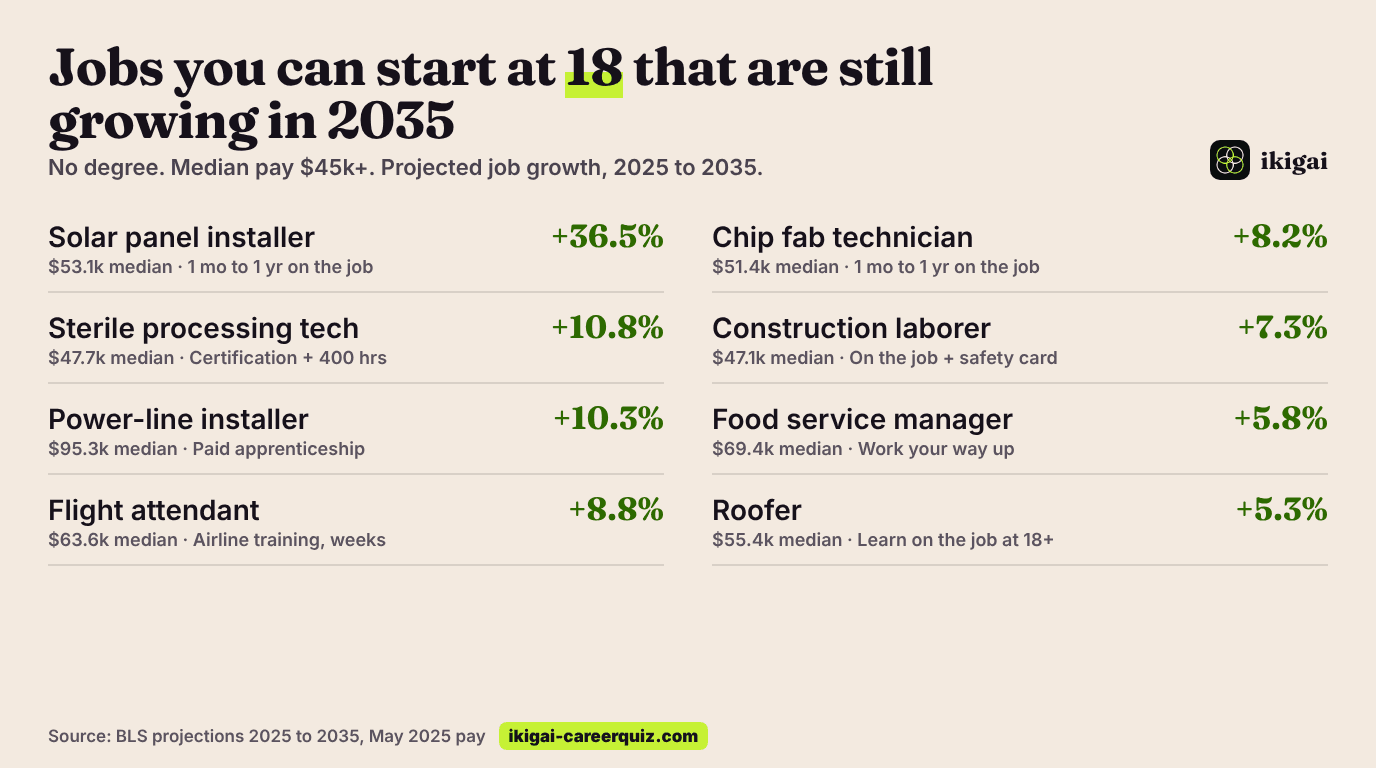
Solar panel installer (+36.5%, $53,140). The fastest-growing job on the list by a mile. The BLS says most installers need a high school diploma and learn on the job in anywhere from 1 month to 1 year. It is a small field (about 31,100 jobs), so growth is fast but openings are local. Comfortable on a roof? This is your tailwind.
Power-line installer (+10.3%, $95,320). The pay champion. Line workers keep the grid running, often in storms and at height. You need a high school diploma, then an apprenticeship that can last up to 3 years, and you get paid while you train. Our data shows about 10,900 openings a year.
Sterile processing tech (+10.8%, $47,700). The hospital job nobody has heard of. These techs clean, sterilize and pack surgical instruments, and operating rooms cannot run without them. The main certification, CRCST, takes a 150-question exam plus 400 hours of hands-on work in a sterile processing department. A real health care career without years of school (for more ideas, see health care careers that are not nursing).
Flight attendant (+8.8%, $63,580). Airlines train you themselves, usually for several weeks to a few months, and you must pass an FAA certification exam. One catch: minimum age is typically 18 or 21 depending on the airline, so check before you apply.
Semiconductor processing technician (+8.2%, $51,430). Chip factories are expanding in the U.S., and the BLS says these techs typically need a high school diploma and 1 month to 1 year of on-the-job training (some do a community college certificate first). You wear the full bunny suit. It is exactly as cool as it sounds.
Construction laborer (+7.3%, $47,120). The biggest door on the list: our data shows about 120,000 openings a year. Most people learn on the job, employers often want an OSHA-compliant safety card, and many laborers later move into a skilled trade through a union or trade association apprenticeship.
Food service manager (+5.8%, $69,390). The "start at 18, run the place by 25" path. The BLS notes most managers start as cooks, servers or supervisors and spend years in the industry first. If you already work in a restaurant, you are on this ladder right now.
Roofer (+5.3%, $55,440). Roofing is one of the jobs federal law keeps mostly off-limits until 18. After that, no formal credential is typically required, and you learn on the job, starting with carrying materials and moving up to measuring and cutting within a few months.
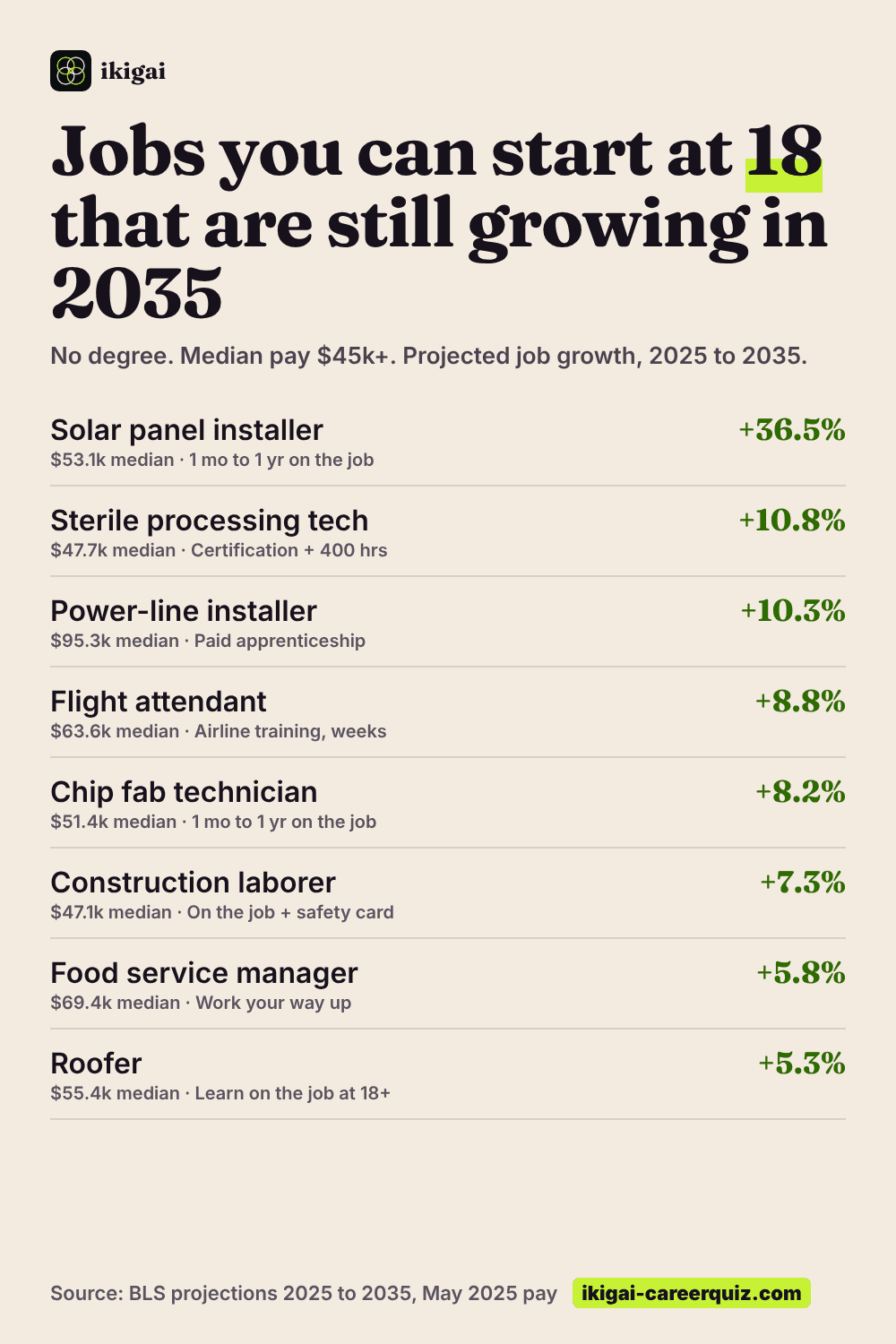
Save the chart
8 jobs you can start at 18, with median pay, 2035 growth and how you get in. Good to have open during the "so what's the plan after graduation?" talk.
Save to PinterestThree patterns worth noticing
1. The pay is in the hands-on jobs. Six of the 8 involve building, fixing or handling physical things. That is not a consolation prize. A power-line installer's median of $95,320 beats plenty of jobs that require a bachelor's degree. For more high earners, see skilled trades that pay well.
2. "Short training" does not mean "no training." Every job here has a learning curve: an apprenticeship, a certification, an airline academy or a year of shadowing. The difference is that you are usually paid while you learn, instead of paying tuition.
3. Starting at 18 is a launch, not a ceiling. Laborers become electricians. Line workers become crew supervisors. Sterile processing techs move into surgical tech or management. Lots of people also go back to school later, often with an employer helping pay. If you are weighing both routes, our trade school vs college breakdown puts pay, debt and growth side by side.
What this list cannot tell you
These are national medians and 10-year projections. Your state, your local utility, union hall or hospital, and whether you actually enjoy working at height or in a hot kitchen all matter more than any table. Some of these jobs also have physical demands and odd hours. Treat this as a list of doors worth knocking on, not a verdict on which one is yours. And if "no degree" is the angle you care about most, our roundup of careers without a degree goes wider.
Find the one that fits you
A job that is growing is only half the answer. The other half is whether it fits how you like to work. Our quiz takes about 7 minutes, maps your interests, strengths and values (including how hands-on you like your work), asks what year you expect to start working, and ranks all 952 careers in our database by fit and projected growth by then. High schoolers can start with our career quiz for high school students guide.
Take the quiz and see which rising careers fit you, whether you start at 18 or 22. Parents, here is how Ikigai helps your teen explore careers.
Sources: Hazardous Occupations Orders (17 nonagricultural orders barring workers under 18 from jobs including roofing, excavation, demolition, power-driven hoisting equipment and most motor vehicle driving) from the U.S. Department of Labor, Wage and Hour Division, child labor provisions for nonagricultural occupations under the FLSA. Entry requirements and training lengths for solar photovoltaic installers, line installers and repairers, flight attendants, semiconductor processing technicians, construction laborers and helpers, food service managers and roofers from the BLS Occupational Outlook Handbook. CRCST requirements (exam plus 400 hands-on hours) from the Healthcare Sterile Processing Association. Career growth (2025 to 2035), annual openings, employment and median pay from BLS Employment Projections and OEWS (May 2025), filtered to O*NET Job Zones 1 and 2, growth above 5%, median pay of $45,000 or more and at least 10,000 jobs, via scripts/blog-jobs-you-can-start-at-18.ts. Entry paths are typical routes, not requirements.
Liked this article?
Get weekly career insights backed by real labor market data. Free, no spam.
Keep reading
Find your Future-Fit Career
7-minute personality quiz. 952 careers. Real BLS data. No account needed.
Take the quiz →