
What Am I Good At? 9 Clues Hiding in Your Everyday Life (and the Careers They Point To)
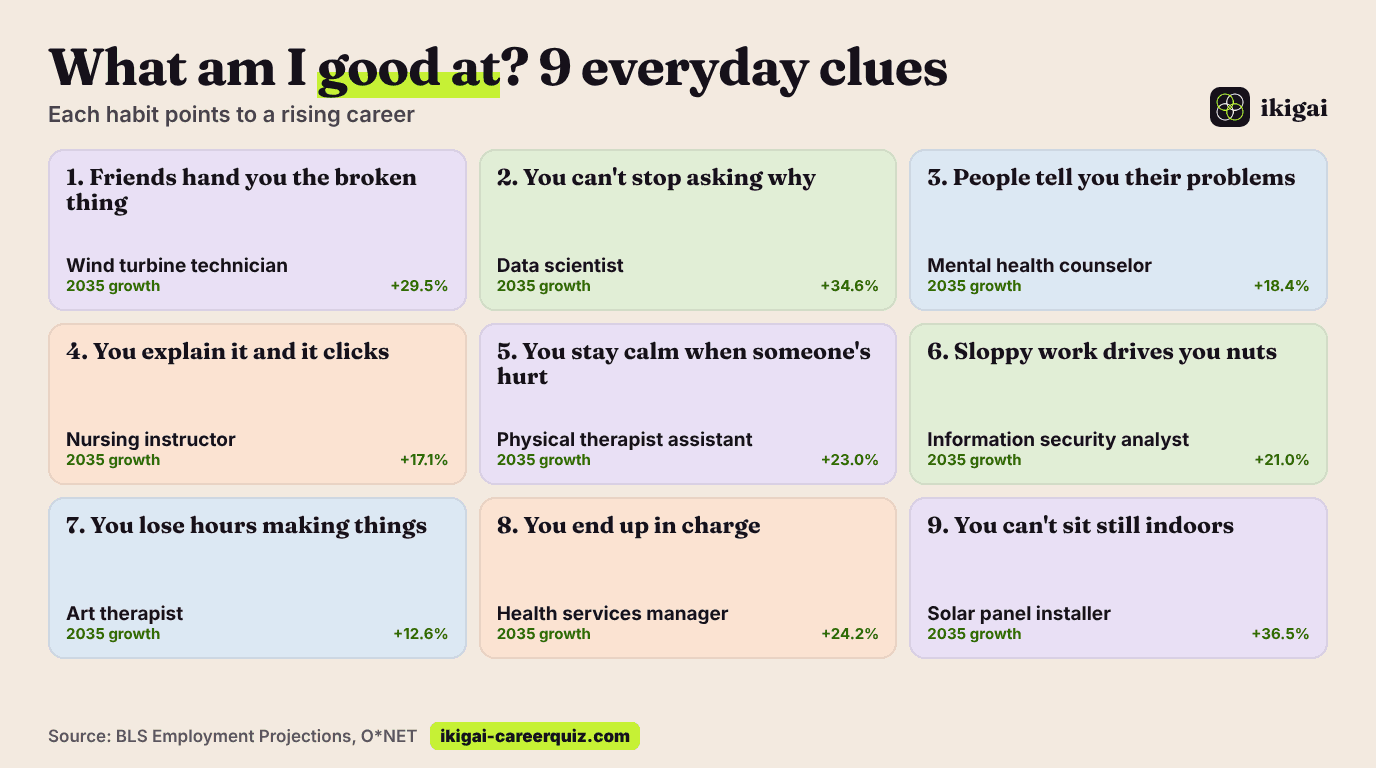
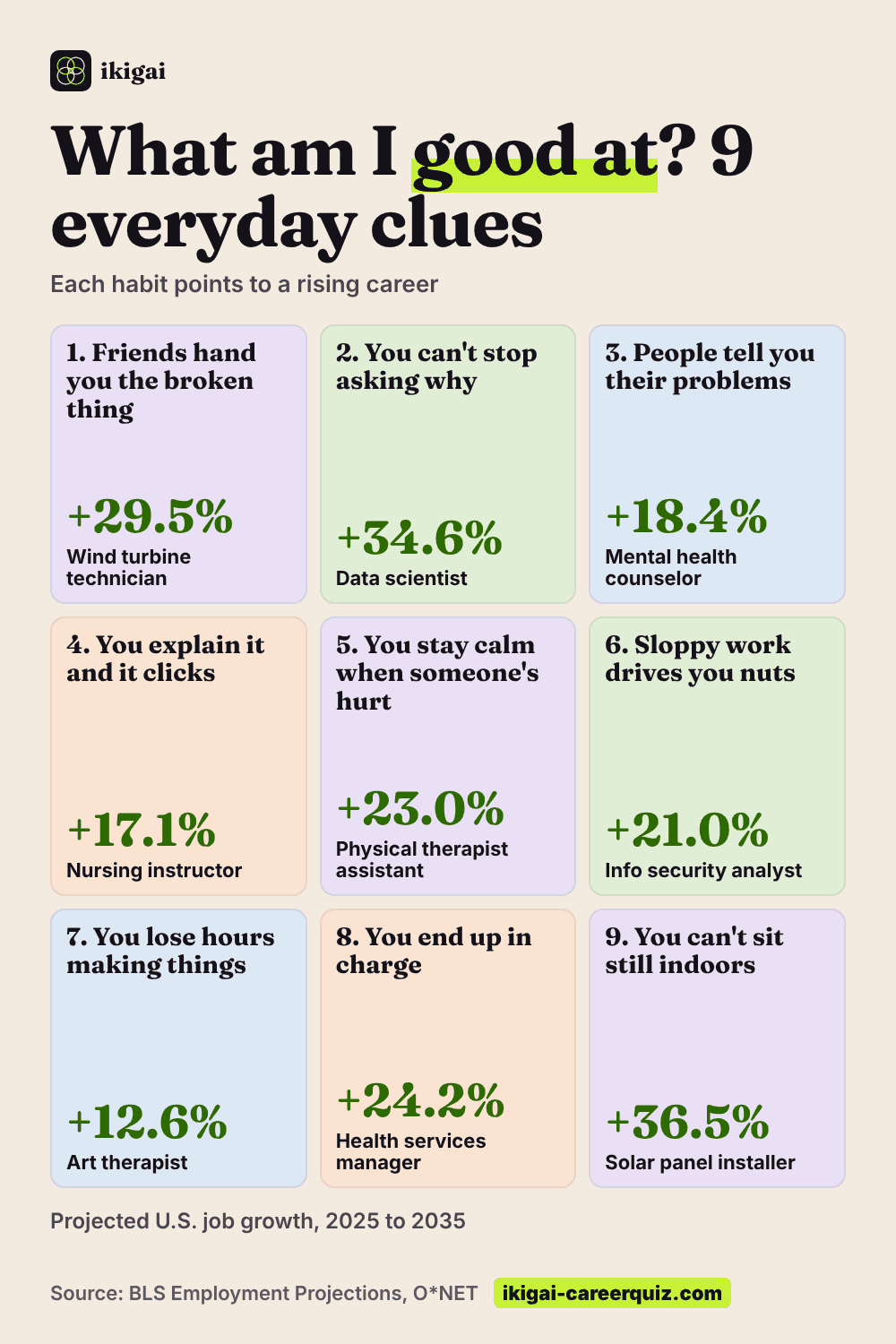
People who use their strengths every day are 6x as likely to be engaged at work. 9 everyday clues to what you're good at, each pointing to rising careers like solar installers (+36.5% by 2035).
Founder of Ikigai · Career data + personality science
"What am I good at?" is a weird question to answer on demand. Someone asks it in a college essay prompt or a job interview and your brain serves up a blank screen and, possibly, "I'm pretty good at Mario Kart."
Here is the thing: you already know the answer. It is just hiding in boring places. In what your friends ask you for. In what makes you lose track of time. In what irritates you when other people do it badly. Strengths rarely announce themselves. They leave clues.
And finding them is worth the effort. Gallup reports that people who use their strengths every day are six times as likely to be engaged in their jobs and three times as likely to say they have an excellent quality of life. So below are 9 everyday clues, what each one says about you, and two careers each one points toward that are projected to grow by 2035.
Why you are bad at seeing your own strengths
It is not just you. Psychologists Ethan Zell and Zlatan Krizan pulled together 22 meta-analyses covering more than 330,000 people and found only a moderate link between how good people think they are at something and how good they actually are. People judged clear, measurable skills (like a foreign language) fairly well, and fuzzier or more complex abilities much less well.
There is a second problem. Your real strengths often feel easy, so you assume they are easy for everyone. The friend who can calm anyone down does not think of it as a talent. They think of it as "being normal." That is why the clues below focus on what you do, not what you think you are good at.
Each clue maps to one of the six interest areas in the RIASEC model (Realistic, Investigative, Artistic, Social, Enterprising, Conventional) that career counselors and our quiz use. Every career listed is projected to grow at least 8% from 2025 to 2035, pays a median of at least $50,000, and already has at least 10,000 U.S. jobs, so these are real options, not unicorns.
The 9 clues (and where they point)
The wobbly chair, the bike chain, the printer nobody else will touch. You like seeing how things work and making them work again.
You fall into research holes for fun. A weird number in a group chat bothers you until you figure out where it came from.
Friends text you at midnight. Strangers on the bus somehow end up telling you about their divorce.
You were the unofficial tutor in every group project. You enjoy the moment when someone finally gets it.
Someone falls, everyone freezes, and you are already holding the ice pack. You like helping with your hands, not just with advice.
You notice the typo, the missed step, the spreadsheet that does not add up. It is not pettiness. It is a skill.
Drawing, editing, building worlds in a game. You look up and it is 2 a.m. and you do not regret it.
Nobody voted, but somehow you are the one making the plan, assigning the jobs and texting everyone the address.
Long classes feel like a sentence. You think better when you are moving, outside, with something real in your hands.
The clues that point outside (and why that is good news)
Three of the nine clues (the broken thing, staying calm when someone is hurt, and not being able to sit still) point to hands-on work. If that is you, you are not looking at a backup plan. You are looking at some of the fastest-rising jobs in the whole economy.
Solar installers are projected to grow 36.5%, faster than data scientists. Wind turbine technicians (+29.5%) get paid to climb things most people would not. Physical therapist assistants (+23.0%, median $68,380) need a 2-year degree and spend the day helping people walk again. And power-line installers earn a median of $95,320, usually after a paid apprenticeship instead of a student loan.
If those clues fit, skilled trades that pay well goes deeper.
Save the chart
9 everyday clues and the rising careers they point to. Send it to the friend who always fixes everyone's stuff.
Save to PinterestA plot twist for the creative ones
Clue 7 was the hardest to fill. In our data, 29 occupations with at least 10,000 workers have Artistic as their strongest interest. Only 1 of them (video game designers) clears our bar of 8% growth and a $50,000 median.
That does not mean creative strengths are a dead end. It means they tend to pay off when paired with a second one. Art plus helping becomes art therapy (+12.6%). Art plus systems becomes game design. If you are mostly a maker, best careers for creative people maps more of those pairings.
How to test a clue (without committing your whole life)
Ask three people. Text three friends or family members: "What do you come to me for?" If two give the same answer, that is a clue with backup.
Notice the annoyance. What do you silently redo after someone else does it? That itch is usually a strength looking for a job.
Try it for a weekend. Shadow someone, take a free intro course, volunteer for a shift. Ten hours of the real thing beats a hundred hours of wondering.
Look for pairs, not one magic talent. Most people do not have one giant strength. They have two or three medium ones that combine in an unusual way. If that sounds like you, not passionate about anything? is written for exactly that.
And remember that strengths and passion are cousins, not twins. You can be good at something you do not love, and love something you are still bad at. Our guide on how to find your passion covers the other half of the question.
A quick reality check
These clues are starting points, not a diagnosis. Plenty of people match three or four of them, and that is a good thing: it means you have options. Growth projections come from the Bureau of Labor Statistics and look about 10 years ahead. If you start working in 2030 or later, treat them as tailwinds worth exploring, not promises.
Let the quiz connect the clues
Reading a list is one thing. Seeing your own pattern is another. Our quiz takes about 7 minutes, maps your interests, strengths, values and how hands-on you like your work, asks what year you expect to start working, and ranks all 952 careers in our database by how well they fit you and how fast they are projected to grow by then.
Take the quiz and find out which of these clues are really yours. Still deciding where to even start? What career is right for me? walks through the bigger picture.
Sources: Career growth (2025 to 2035) from BLS Employment Projections; median pay from BLS OEWS (May 2025); interest profiles (RIASEC) from O*NET; filters (growth of 8% or more, median pay of $50,000 or more, at least 10,000 U.S. jobs) and the Artistic count via scripts/blog-what-am-i-good-at.ts. Strengths and engagement finding from Gallup, "Uniquely You: How Your Strengths Set You Apart" (Jim Asplund, 2021). Self-assessment accuracy from Zell and Krizan, "Do People Have Insight Into Their Abilities? A Metasynthesis," Perspectives on Psychological Science (2014), as reported by the Association for Psychological Science and ScienceDaily. Clue-to-career pairings are illustrative; typical entry paths are common routes, not requirements. Mental health counselors share one BLS projection category with substance abuse counselors.
Liked this article?
Get weekly career insights backed by real labor market data. Free, no spam.
Keep reading
Find your Future-Fit Career
7-minute personality quiz. 952 careers. Real BLS data. No account needed.
Take the quiz →