
Stuck With a "Useless" Degree? 15 Rising Careers for Comms, Poli Sci, Psych and Gen Ed Grads
53% of recent communications grads work jobs that do not need a degree. Here are 15 rising careers for comms, poli sci, psych and general studies grads, each projected to grow through 2035, including pivots that skip a second bachelor's.
Founder of Ikigai · Career data + personality science
A political science junior at the University of Kansas put it bluntly to the Lawrence Journal-World this week: a bachelor's degree is now "sort of like the old high school diploma." Painful, and not totally wrong. According to the Federal Reserve Bank of New York, 42% of recent college grads were underemployed in mid-2026, meaning their job does not usually require a degree. For communications majors the figure is 53%. For liberal arts, 54.6%.
The entry level also got smaller. ZipRecruiter found entry-level roles were 38.6% of job postings in March 2026, down from 44% in 2023. So if you are 24, holding a comms or poli sci diploma and pouring lattes, the problem is not you. The front door shrank.
But "useless" is the wrong word. Your degree is not useless. It is pointed at the wrong job titles. So we took four of the most mocked majors, looked up the "obvious" job each one leads to, and then went looking in the government's own projections for careers that are actually growing and that your degree helps you get into.
First, the obvious jobs are the problem
Here is the pattern that explains a lot of regret. ZipRecruiter's 2026 grad survey found 46.3% of recent political science, IR and public policy grads wish they had picked another major, along with 39.2% of communications grads and 35% of general studies grads. (We broke down the full list in the most regretted college majors of 2026.)
Now look at the job titles those degrees are named after. Political scientists: projected to shrink 2.0% by 2035. Public relations specialists: up just 1.8%. Reporters: down 5.9%. School psychologists: up 0.8%. All U.S. jobs combined are projected to grow 3.5%, so these are below average or going backwards.
Meanwhile, the Bureau of Labor Statistics expects healthcare and social assistance to produce about 37% of all new U.S. jobs through 2035. That number does a lot of work in the list below.
15 rising careers, by degree
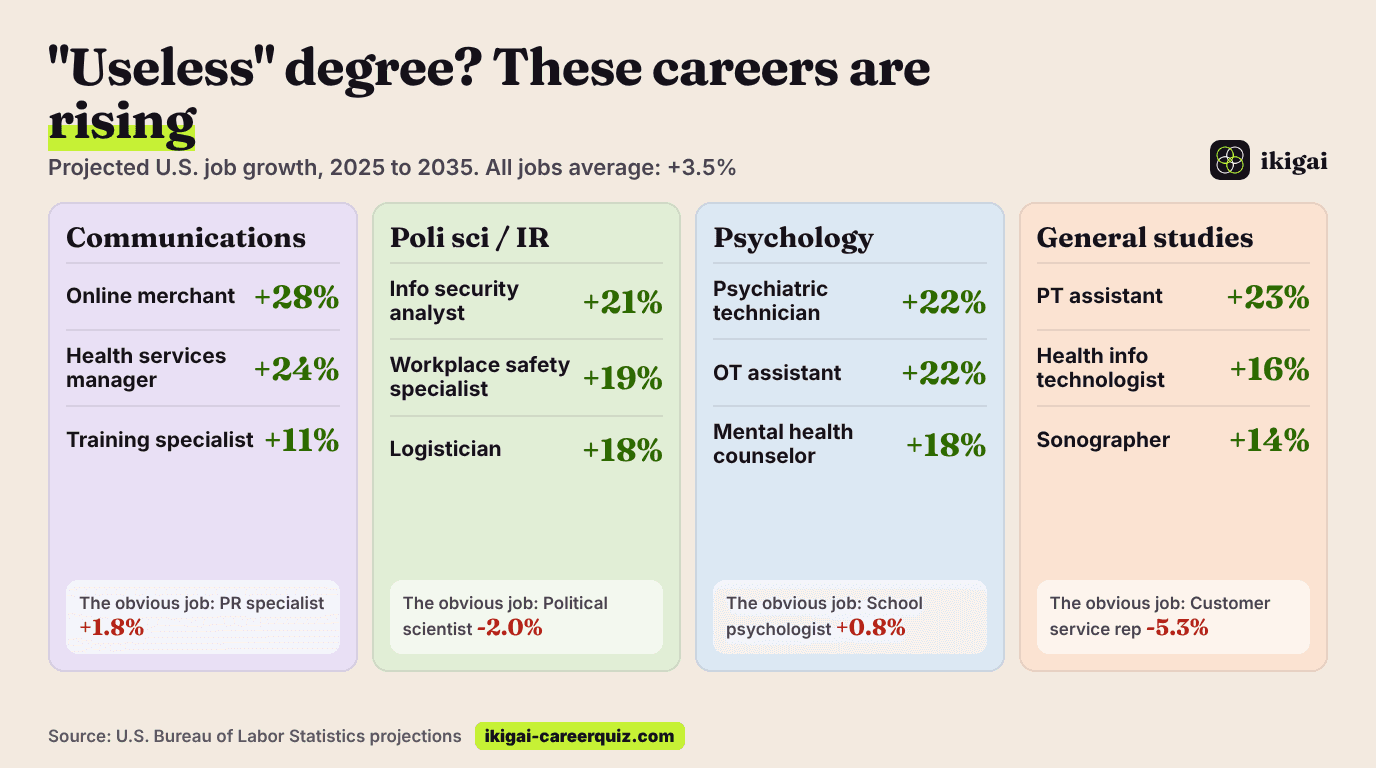
For each degree we picked three or four careers with strong projected growth (10% or more from 2025 to 2035 in all but one case), real job counts and a believable route in from that degree. We made sure each degree has at least one pivot that does not need a second bachelor's, because those are often the fastest way out of underemployment.
Communications
The obvious job: Public relations specialists +1.8%. The skill is everywhere, which is exactly why the title is crowded. Reporters are projected to shrink 5.9%. The fix is attaching your writing and people skills to an industry that is growing.
Political science / IR
The obvious job: Political scientists -2.0%. The title itself employs about 6,100 people in the whole country and is projected to shrink. What transfers is reading rules carefully, writing briefs and thinking about risk.
Psychology
The obvious job: School psychologists +0.8%. The famous path runs through grad school. Clinical and counseling psychologists are growing 11.7%, but that usually means a doctorate. The bachelor's is a strong base for faster routes into care.
General studies / liberal arts
The obvious job: Customer service representatives -5.3%. The degree is broad, so the move is one specific credential on top. All three of these usually take an associate degree or certificate, not a second bachelor's.
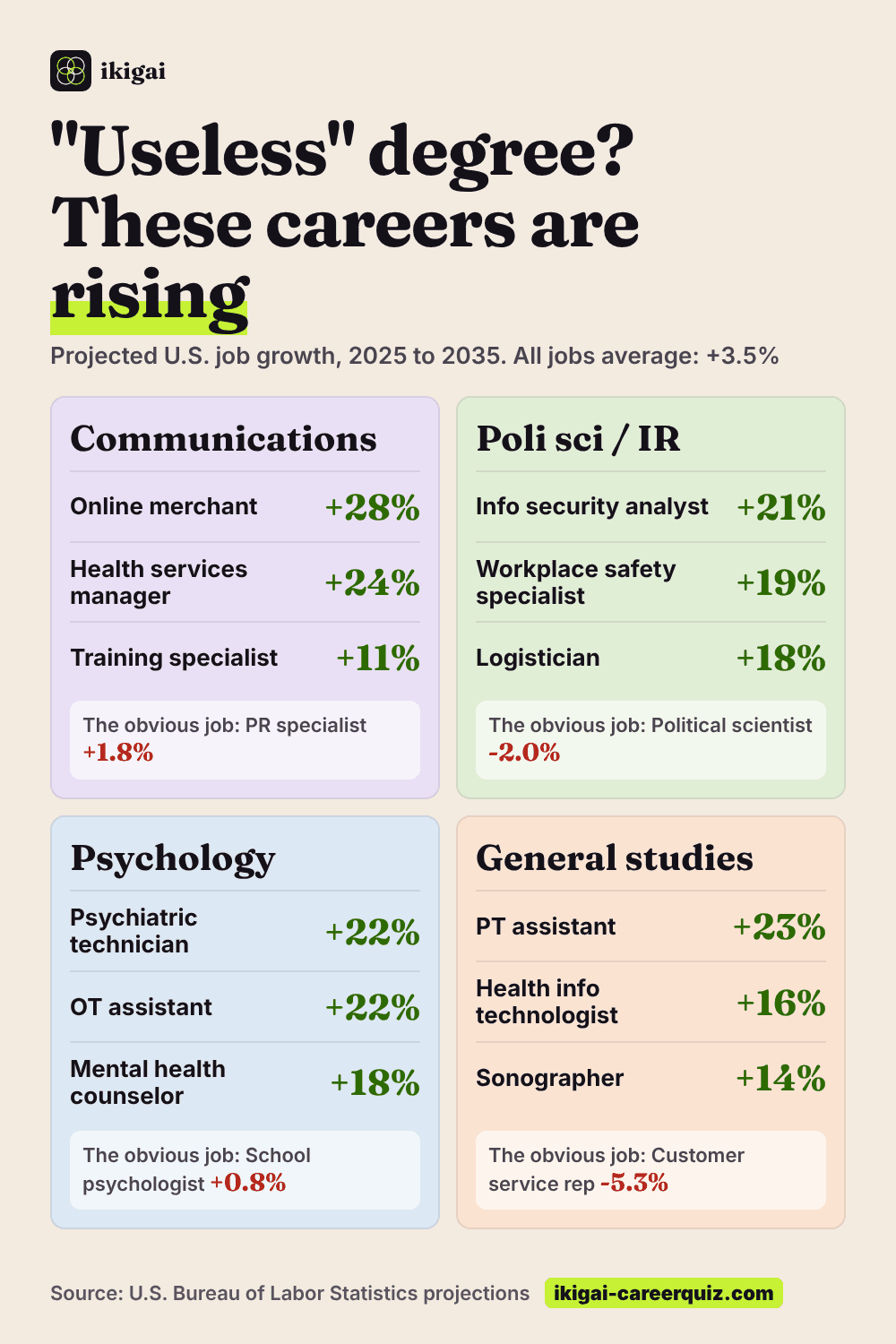
Save the chart
All four degrees on one page, with the obvious job next to the rising ones. For the next time a relative asks what you are going to do with that.
Save to PinterestWhat the list has in common
Three things jump out when you put all 15 side by side:
- They are growing about five times faster than average. The 15 average 18% projected growth through 2035, against 3.5% for all jobs.
- More than half are in healthcare. Eight of the 15, which tracks with that 37% BLS figure. None of them are nursing or medical school. If that surprises you, we have a whole post on healthcare careers that are not nursing.
- Six of the 15 do not usually need another bachelor's. A certificate, an associate degree or employer training is the typical route. Your existing degree is not wasted there: it can cover gen ed credits and it reads well to hiring managers. More options like these are in the fastest-growing jobs with two years of training.
The median pay across the 15 sits at about $82,320. Not every route is fast or cheap, and some (counseling, speech pathology) mean grad school. But none of them require pretending your degree never happened.
How to make the pivot without starting over
- Translate the degree into verbs. Nobody hires "a poli sci grad." They hire someone who can research, write a clear recommendation and handle a difficult conversation. Rewrite your resume around what you can do, not what you studied.
- Add one specific credential. A certificate, a license or a short program is usually the difference between "has a vague degree" and "is qualified for this job." Pick it based on the growth numbers, not on what sounds impressive.
- Get in the building first. Coordinator, assistant and technician roles in growing fields are often the side door. In healthcare administration, for example, a clinic coordinator job is a common first rung.
- Test before you pay tuition. Shadow someone, volunteer for a shift, or talk to two people who do the job. A weekend of research is cheaper than a semester of regret.
If you are a few years out and feeling behind, our quarter-life career change guide covers the money and timing side. And if you genuinely do not know which direction excites you, start with how to pick a career when you are not passionate about anything.
A note on what this data can and cannot tell you
BLS projections are a 10-year view of where hiring is likely to grow nationally. They are not a promise for your city, and they cannot see a surprise recession or a breakthrough coming. Treat this list as a map of tailwinds, not a verdict on your life. Plenty of comms and poli sci grads build great careers in PR, campaigns and law. The point is that you have more doors than the one printed on your diploma.
Find the rising careers that fit you
A list built around your major is a start. A list built around you is better. Our quiz takes about 7 minutes, maps your interests, strengths and values, asks when you expect to start full-time work, and ranks all 952 careers in our database by how well they fit you and how they are projected to grow by then.
Take the quiz and see which rising careers line up with the person who earned that degree, not just the degree.
Sources: recent-graduate underemployment (ages 22 to 27, 2026 Q2) from the Federal Reserve Bank of New York, "The Labor Market for Recent College Graduates." Underemployment by major (communications 53.0%, liberal arts 54.6%) from the New York Fed's February 2026 update, as reported by Forbes (February 23, 2026). Student quote from the Lawrence Journal-World (October 23, 2026). Entry-level share of postings from ZipRecruiter, as reported by Fortune (April 24, 2026). Regret rates from ZipRecruiter's 2026 grad survey, as reported by Newser (April 25, 2026). Healthcare share of new jobs and all-jobs growth (3.5%) from the BLS Employment Projections news release (August 27, 2026). Career growth (2025 to 2035) and median pay from U.S. Bureau of Labor Statistics Employment Projections and OEWS (May 2025). Typical entry paths are common routes, not the only ones; degree-to-career pairings are exploratory, not predictive.
Liked this article?
Get weekly career insights backed by real labor market data. Free, no spam.
Keep reading
Find your Future-Fit Career
7-minute personality quiz. 952 careers. Real BLS data. No account needed.
Take the quiz →