
Low-Stress Jobs That Pay Well (and Will Still Exist in 2035)
39% of U.S. workers say they are burned out right now. Here are 21 calmer careers in three pay bands, each projected to grow through 2035, plus the "chill" jobs that are secretly stressful.
Founder of Ikigai · Career data + personality science
Fresh from last week: 39% of U.S. employees say they are experiencing burnout in their current job, according to Aflac's 2026-2027 WorkForces Report, released October 13. Gallup's latest numbers say half of U.S. workers felt stress for a lot of the previous day. And in a SupplyHouse survey reported by Fortune this spring, about 75% of Gen Z said they associate desk jobs with burnout and instability.
So it makes sense that "low stress jobs that pay well" is one of the most searched career phrases out there. The problem is that most of the lists ranking for it were written years ago, and none of them ask the question that matters if you are about to retrain: will this calm, decent-paying job still be hiring in ten years?
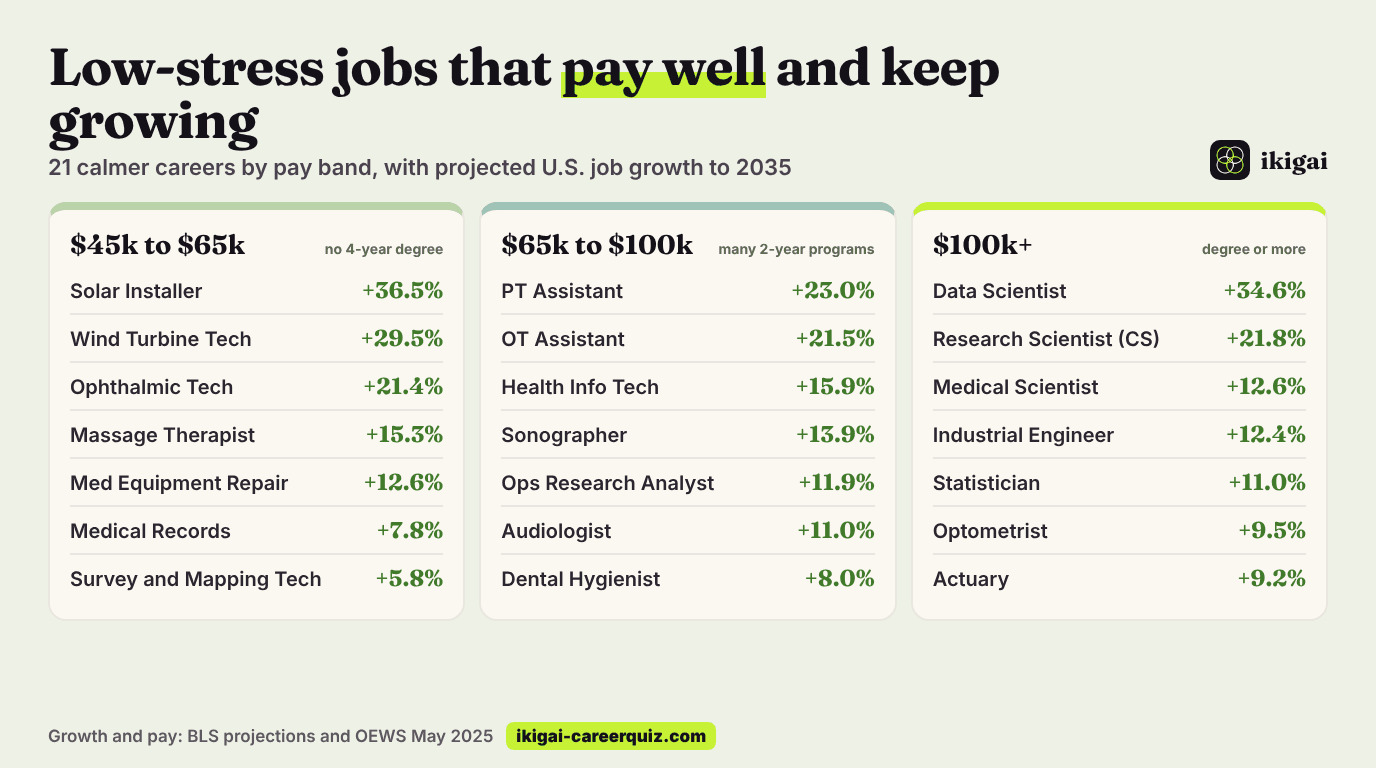
We asked it. Here are 21 calmer careers, in three pay bands, every one of them projected to grow through 2035.
Why "calm" is beating "dream job"
For a while the career advice was: find your passion, and the hours will not feel like work. A lot of people found their passion, then found that the passion came with an inbox, a pager and a manager in a different time zone. (If you are not sure whether what you are feeling is a bad week or the real thing, start with our guide to career burnout signs.)
Wanting a job that does not eat your evenings is not a lack of ambition. It is a design spec. Aflac found that 53% of Gen Z would trade some salary for stronger benefits. People are pricing in their sanity. The good news: you do not have to trade as much pay as you might think.
How we picked them (honestly)
There is no single official "stress score" in the government's job data, and we are not going to pretend otherwise. Here is exactly what we did:
- A calm screen. Every job had to pass four checks: no routine emergencies or life-or-death calls, no commission or sales-quota pay, mostly scheduled hours rather than default on-call or overnight shifts, and little front-line conflict (no enforcement, collections or angry-customer queues).
- A future screen. Projected U.S. employment growth above zero from 2025 to 2035, using the Bureau of Labor Statistics projections our quiz runs on.
- A real-job screen. At least 10,000 people doing it today, and a published BLS median wage.
A fun detail: we first tried scoring stress with the work-values ratings in our database. The jobs that rated highest on "working conditions" included critical care nurses, emergency medicine physicians, air traffic controllers and explosives handlers. Great conditions, sure. Calm, no. So we used the transparent screen above instead, and we are telling you so.
21 low-stress jobs that pay well, by pay band
Sorted by projected growth within each band. Median pay is the U.S. median from May 2025. Tap any job for the full profile.
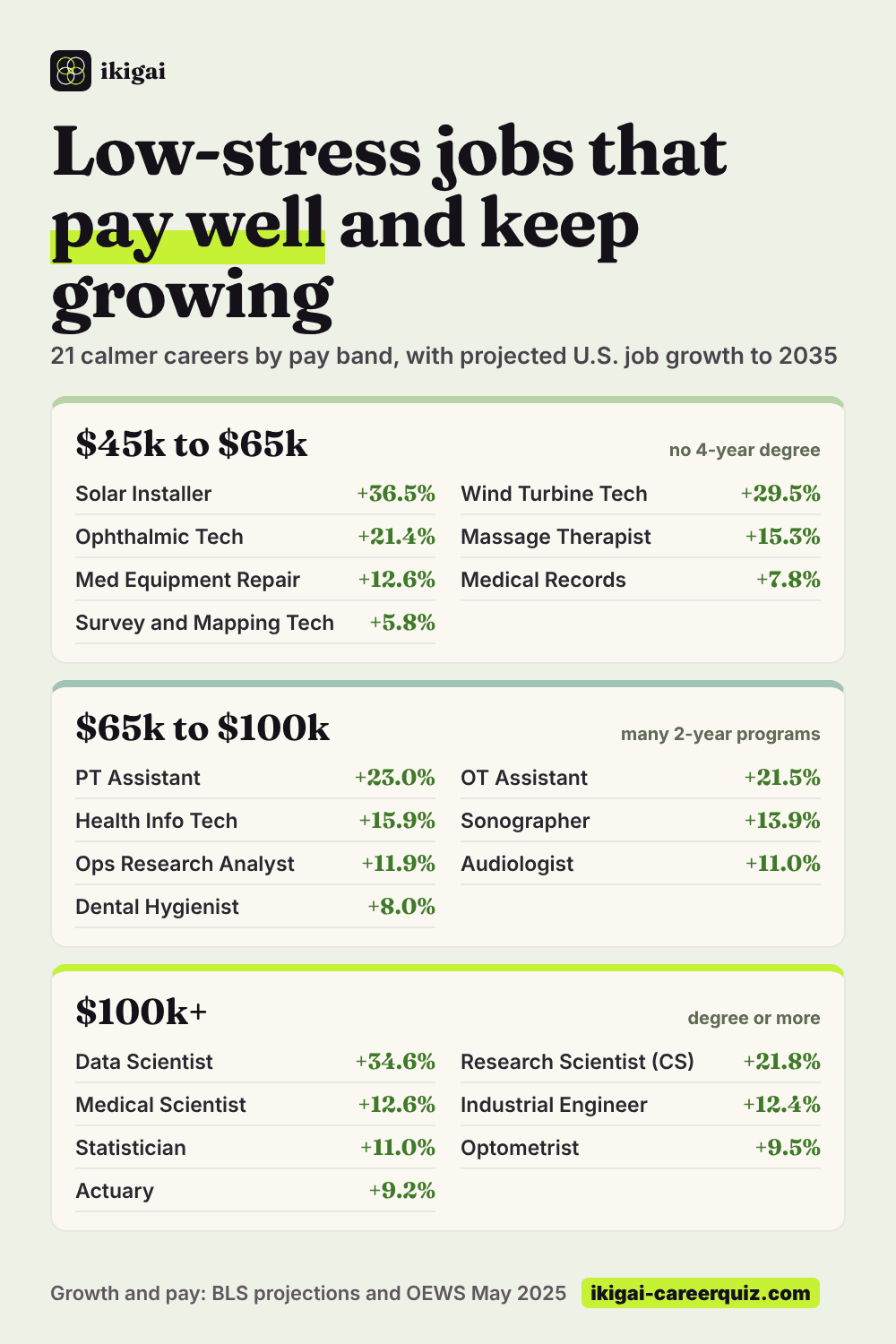
Save the chart for later
All 21 calmer careers on one page. For the next time your Sunday night feels like a Monday.
Save to PinterestNo degree vs. degree: the plot twist
Count them up: 12 of the 21 do not typically require a bachelor's degree. The whole first band runs on certificates, licenses and on-the-job training, and five of the middle band (PT and OT assistants, health information technologists, sonographers and dental hygienists) usually start with a two-year program or less. Dental hygienists and sonographers both have medians within a few thousand dollars of $100,000.
That matters if you are burnt out at 27 and the idea of four more years of school sounds like its own kind of stress. We went deeper on these routes in the fastest-growing jobs with two years of training, and on the health side specifically in healthcare careers that are not nursing.
The $100k band is mostly analytical work that rewards long focus: data, research, statistics, engineering, clinical optometry. The stress profile there is different. It is "this model will not converge" stress, not "a stranger is yelling at me" stress. Many people find the first kind far easier to live with.
The "chill" jobs that are secretly stressful
Some jobs get recommended as low stress because they look calm from the outside. These pay well and are still growing, so they are worth a look, just with clear eyes.
None of these are bad careers. Information security analysts are one of the fastest-growing high-paying jobs in the country. But if your goal is fewer 2am adrenaline spikes, it is worth knowing which jobs come with them.
What "low stress" cannot promise you
- Stress is mostly about the workplace, not the title. A calm job under a chaotic manager is a stressful job. A sonographer in a well-run clinic and one in an understaffed hospital have very different weeks.
- Calm is personal. Some people find a quiet records office relaxing; others find it suffocating. Boredom is a stressor too.
- Projections are tailwinds, not guarantees. BLS projects 2025 to 2035. These jobs are rising on that horizon, which is a good sign, not a promise.
Find the calm job that also fits you
A low-stress job you are bad at is not low stress. The sweet spot is work that fits how you are wired, pays enough, and is growing by the time you would be ready to start. That is what our quiz is built to find. It takes about 7 minutes, asks when you expect to start your next full-time role, and ranks all 952 careers in our database by fit and projected demand at that point.
If you are thinking about a switch, our quarter-life career change guide covers the logistics. Or skip straight to taking the quiz and see which calmer careers are rising for you.
Sources: burnout and salary-for-benefits figures from the 2026-2027 Aflac WorkForces Report, conducted by Kantar among 2,001 U.S. employees and 1,000 employers (released October 13, 2026). Daily stress from Gallup's State of the Global Workplace 2026 report (U.S. data). Gen Z desk-job figure from SupplyHouse research reported by Fortune (April 9, 2026). Career growth (2025 to 2035), employment and median pay from U.S. Bureau of Labor Statistics Employment Projections and OEWS (May 2025); typical entry paths are common routes, not the only ones. "Calm" reflects our editorial screen described above, not a measured stress score, and is offered as exploration, not prediction.
Liked this article?
Get weekly career insights backed by real labor market data. Free, no spam.
Keep reading
Find your Future-Fit Career
7-minute personality quiz. 952 careers. Real BLS data. No account needed.
Take the quiz →