
The Most Regretted College Majors of 2026 (and What Grads Wish They'd Picked)
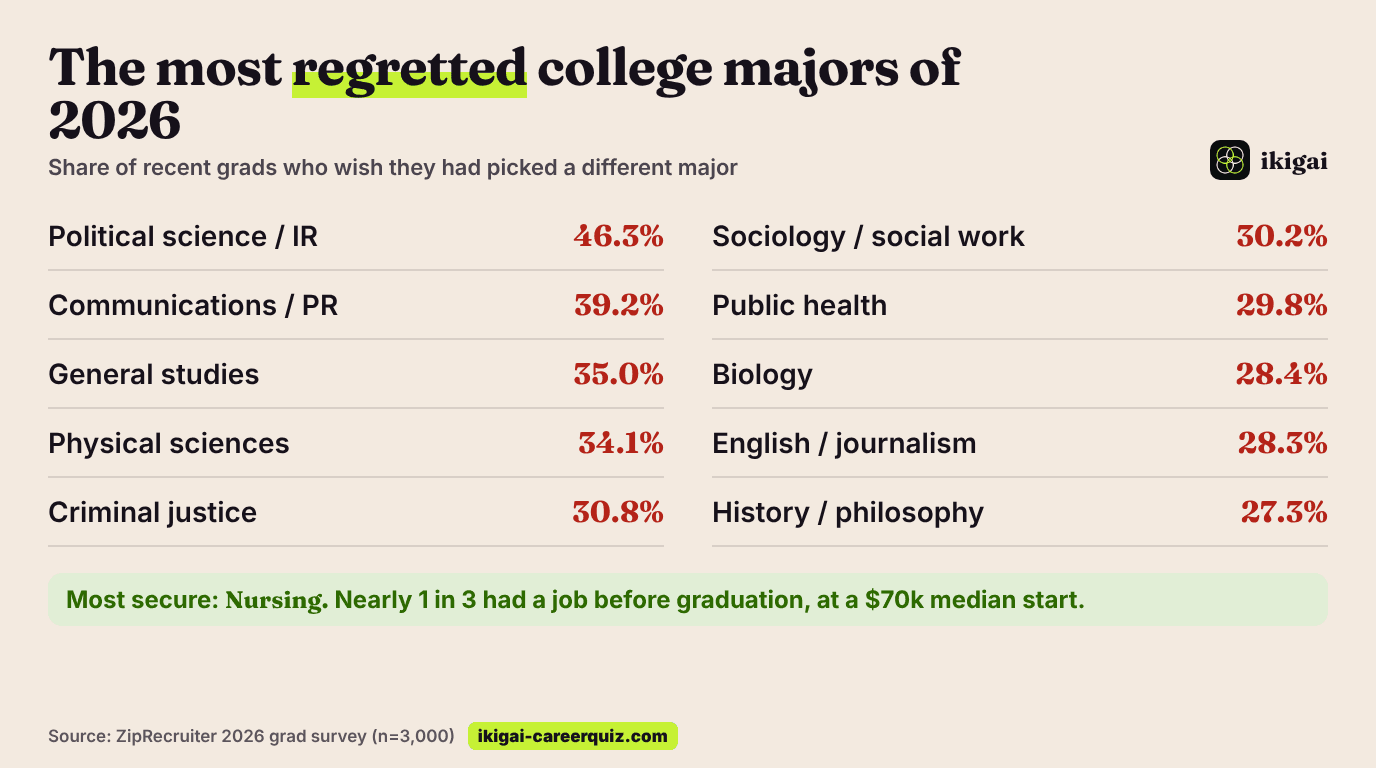
46% of recent political science grads wish they had picked a different major. Here are the 10 most regretted majors of 2026, the rising careers each one still leads to, and what to ask before the deposit.
Founder of Ikigai · Career data + personality science
Here is a number to bring up at Thanksgiving: 46.3% of recent political science, international relations and public policy grads say they wish they had picked a different major. That is the top of ZipRecruiter's 2026 grad survey, which asked 3,000 people from the class of 2025 and the class of 2026 one blunt question: knowing what you know now, would you choose the same major?
The timing matters. The 2027-28 FAFSA opened in late September, the earliest launch ever, and early decision and early action deadlines land on November 1 at a lot of schools. Families are picking majors (or at least checking a box) right now. And according to a HelloCollege survey released this morning, 37% of college students say they are already shifting their career plans because of AI.
So we took the 10 most regretted majors and asked a more useful question than "which major is bad?" For each one, where does the government's own data say the growth actually is?
First, the good news nobody leads with
Overall, roughly one in five recent grads regret their major. That means about four in five do not, including plenty of poli sci and comms grads. Regret is a signal worth reading, not a sentence.
And read closely, the regret is almost never about the subject. People rarely say "I wish I had not learned about political systems." They say the first job was hard to find, the title was fuzzy, or the pay did not match the loan. That is a job market problem, and job market problems have workarounds.
The 10 most regretted majors of 2026, and where each one still leads
Ranked by the share of grads who wish they had chosen differently. Under each: the honest reason, then rising careers the major feeds into, with projected U.S. growth from 2025 to 2035 and median pay. Click any career for the full profile.
The pattern hiding in that list
Look at where the green numbers cluster. Healthcare shows up under comms, general studies, sociology, public health and biology. Data and security show up under poli sci, physical sciences and criminal justice. And the hands-on routes keep popping up in places you would not expect: a physics grad who becomes a wind turbine tech, a general studies grad who adds a two-year PTA program and lands in a field growing 23%. Those are not consolation prizes. Several pay more than the "obvious" job for the same major.
The other pattern: the regretted majors are the ones where the degree and the job title do not line up. Nobody asks a nursing grad what they plan to do with that. A comms grad hears it at every family dinner. The fix is rarely a different major. It is a clearer target. (If you are still choosing, our guide on how to choose a college major walks through it.)
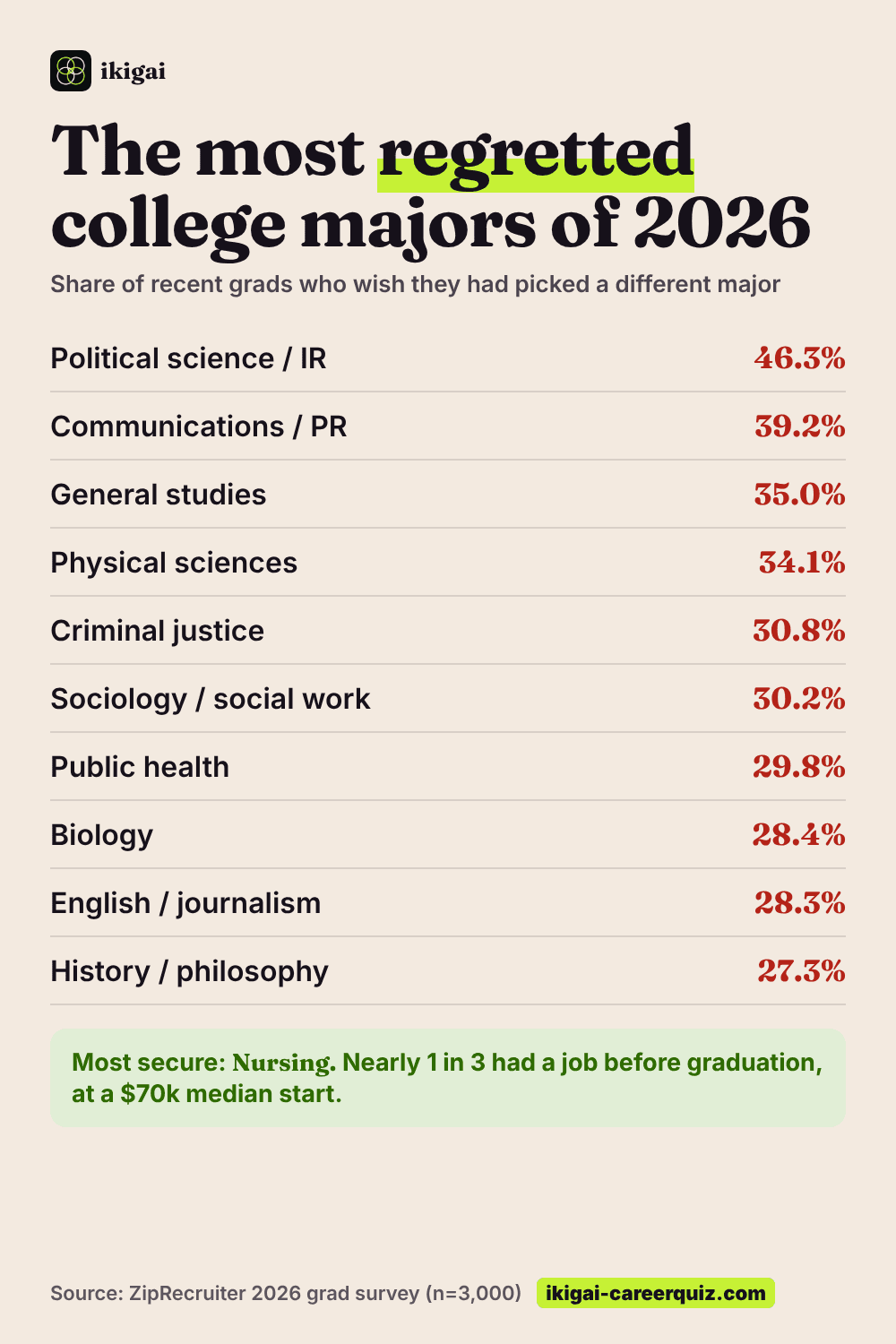
Save the chart for later
All 10 regret rates on one page. Send it to the senior filling out applications this week (gently).
Save to PinterestThe computer science twist
Computer science is not on the regret list. Students are fleeing it anyway. The National Student Clearinghouse reported that undergraduate computer science enrollment at four-year schools fell 8.4% in spring 2026, while health professions and engineering grew. It is hard not to read that as the AI headlines at work.
Is it an overreaction? The projections say: partly. Here is the computer cluster, side by side.
The job that is literally "write the code someone else designed" (computer programmers) is shrinking. The jobs that use code to solve messy problems (data science, security, software development, AI research) are still growing, and software developers alone are projected to have about 95,300 openings a year. CS is not dead. The version of CS that is only typing syntax is the part under pressure. For the full picture on which roles are hardest for AI to touch, see our AI-proof careers list.
The most secure major: nursing
ZipRecruiter called nursing the most secure field in the survey: nearly a third of nursing majors had a job lined up before graduation, and nursing grads reported the highest median starting pay at $70,000. The projections back it up. Registered nurses are expected to have about 180,800 openings a year through 2035, and nurse practitioners are the fastest-growing big job in the country at +41.0%.
The catch is that nursing is a calling with night shifts, not a safe default. If the appeal is security rather than patients, there are rising healthcare roles that look nothing like the hospital floor. We rounded them up in healthcare careers that are not nursing.
For parents: what to ask before the deposit
You do not need to pick your kid's major. You do need to help them see the road past it. Before an early decision form or a May deposit, try these:
- "Name three job titles this major leads to." Not "something in policy." Real titles. If they cannot name three, that is not a reason to switch, it is homework. The list above is a decent starting point.
- "Which of those are growing by the time you graduate?" A student starting college next fall graduates around 2031. Check the projections for that window, not for today.
- "What would you add to make it specific?" A minor in data, a certificate, an internship, a two-year clinical program after. The regretted majors become a lot less regrettable with one concrete add-on.
Notice none of these are "is this major worth it?" That question starts arguments. These start plans. (More on that in career advice parents get wrong.)
What this data cannot tell you
- Regret is a survey answer, not a destiny. It measures how grads feel one or two years out, in a tough entry-level market. Ask the same people at 35 and plenty of answers change.
- Projections run ten years. BLS projects 2025 to 2035. A ninth grader today enters full-time work around the far edge of that window, so treat the growth numbers as tailwinds, not guarantees.
- Majors are not job titles. The careers above are common paths, not the only ones. Plenty of poli sci grads end up in tech, and plenty of biology grads end up running companies.
Find the major that leads somewhere rising
The best defense against major regret is starting from the career end instead of the course catalog: what kind of work fits you, and which of those jobs are growing when you get there. That is exactly what our quiz does. It takes about 7 minutes, asks the year you expect to start full-time work, and ranks all 952 careers in our database by how well they fit and how much demand they are projected to have at that point.
Parents, we built a page just for you: send your teen the quiz and compare notes over dinner instead of arguing about majors. Or, if you are the student, take the quiz yourself and walk into that conversation with data.
Sources: regret rates from ZipRecruiter's 2026 grad survey of 3,000 members of the classes of 2025 and 2026, as reported by CBS News (April 24, 2026) and Newser (April 25, 2026), including the nursing job-offer and $70,000 starting pay figures. Computer science enrollment from the National Student Clearinghouse Research Center (August 11, 2026). AI and career plans from HelloCollege's 2026 College Student AI Survey (October 21, 2026). FAFSA launch from Sinclair national news (September 24, 2026). Career growth (2025 to 2035), annual openings and median pay from U.S. Bureau of Labor Statistics Employment Projections and OEWS (May 2025). Major-to-career pairings are common paths, offered as exploration, not prediction.
Liked this article?
Get weekly career insights backed by real labor market data. Free, no spam.
Keep reading
Find your Future-Fit Career
7-minute personality quiz. 952 careers. Real BLS data. No account needed.
Take the quiz →