
Should I Quit My Job in This Economy? A Brutally Honest Flowchart
55% of Gen Z professionals plan to job-hunt this year, in a month that added just 29,000 U.S. jobs. A 4-question flowchart for deciding whether to quit, hug your job, or test a rising field first.
Founder of Ikigai · Career data + personality science
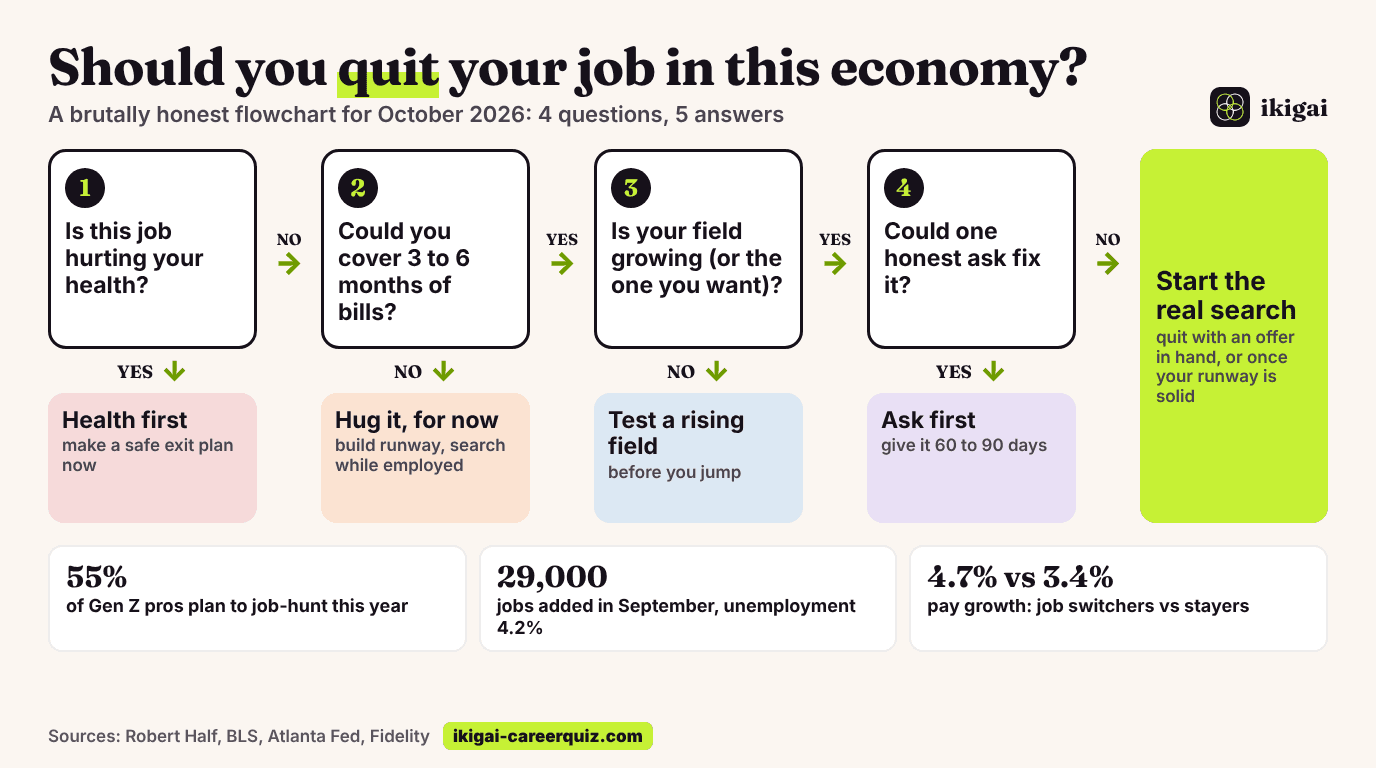
Here is the mood in two numbers. A Robert Half survey found 55% of young U.S. professionals planned to look for a new job this year, up from 32% the year before. Meanwhile, the U.S. economy added just 29,000 jobs in September, unemployment ticked up to 4.2%, and July was revised to a loss.
So half of Gen Z wants out, and the door is narrower than it has been in years. Workers have a name for staying put when you would rather leave: job hugging. You can see it in the data. In August, only 1.9% of workers quit their jobs, according to the Bureau of Labor Statistics. And October brought fresh layoff headlines from Netflix (about 1,000 roles) and HubSpot (about 660).
Nobody can tell you whether to quit. But most people asking the question are actually tangled up in four separate questions. Untangle them in order and the answer usually gets obvious.
The flowchart
Start at 1. If your answer matches the exit, follow it. If not, keep going down.
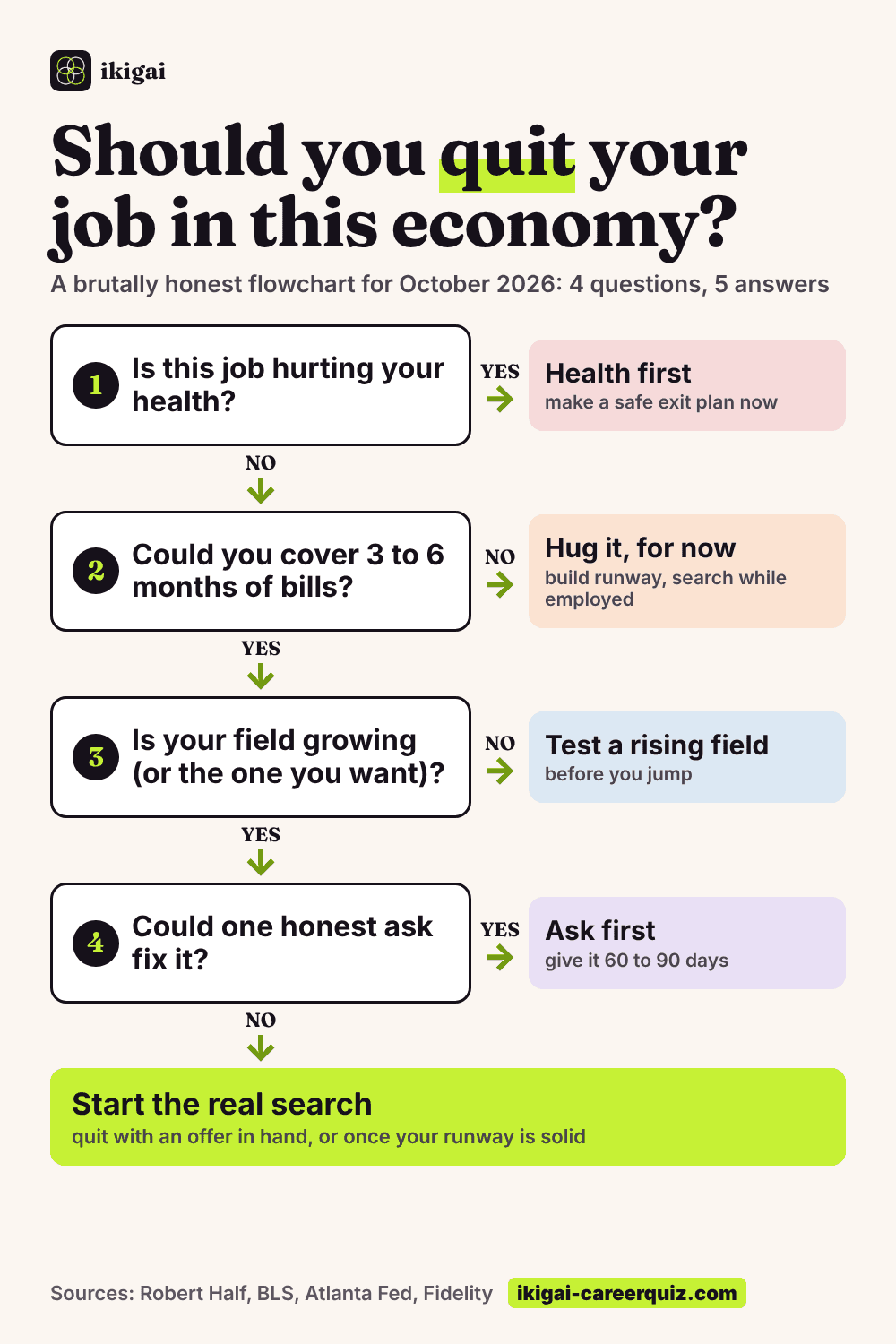
Save the flowchart
For the next Sunday night when you are drafting a resignation email in your head. Four questions, five honest answers.
Save to Pinterest1. Is the job hurting your health?
This comes first on purpose. If the job is wrecking your sleep, your mental health or your body, the state of the labor market is a secondary issue. That does not mean walking out tomorrow with nothing lined up. It means making a plan with a short deadline: talk to a doctor, ask HR what leave options you have, and start the search this week instead of "after the holidays."
Bad weeks are normal. A job that makes you dread every Sunday for months is a different thing, and it deserves a real answer.
2. Could you cover 3 to 6 months of bills?
Fidelity's rule of thumb for an emergency fund is 3 to 6 months of essential expenses. Essential means rent, food, insurance, minimum debt payments and getting around. Not your current lifestyle.
In this market, plan for the long end. In September, 27.1% of unemployed Americans had been looking for work for 27 weeks or more, per the BLS. That is about one in four job seekers searching for over six months. If you cannot cover that stretch, the honest answer is to hug the job for now. Not forever: just long enough to build a cushion and search from a position of calm.
That is what people call career cushioning: staying in your role while you quietly build options. Update the resume, take one class, have one coffee a week with someone in a field you are curious about. It is not disloyal. It is just not being caught flat-footed.
3. Is your field growing?
This is the question most quit advice skips, and it changes everything. Leaving a job in a growing field means you are walking into a market that wants you. Leaving a job in a shrinking field can mean competing harder for fewer seats.
Here is how some of the most common jobs look in the government's 2025 to 2035 projections. Openings are average job openings per year, and for context, all U.S. jobs combined are projected to grow 3.5%.
Notice the twist in the openings column. Customer service jobs are projected to shrink 5.3%, yet there are still about 289,500 openings a year, because people constantly leave those jobs. So "shrinking" does not mean "no one is hiring." It means less leverage: fewer bidding wars, slower raises, and more risk that the next job is a sideways move.
If your field is on the red side, quitting into the same title elsewhere may not fix much. That is the moment to look sideways. Our breakdown of the jobs disappearing by 2035 and the ones taking their place pairs shrinking jobs with rising ones that use similar skills.
Test a rising field before you jump
The worst version of quitting is leaving a job you dislike for a field you have never actually tried. The fix is cheap: test first, while you are still getting paid. All six careers below are projected to grow at least 10% by 2035 and usually do not need a bachelor's degree.
Want more like these? See the fastest-growing jobs with two years of training. And if the real issue is burnout more than the field itself, our list of low-stress jobs that pay well is a gentler place to start.
4. Could one honest conversation fix it?
Lots of people quit over things that were negotiable: a schedule, a manager, a workload, a raise they never asked for. Before you leave, try naming the specific fix you want, out loud, to the person who can approve it. Then give it 60 to 90 days.
Pay is a big one here, so it helps to know the real math. The Atlanta Fed's Wage Growth Tracker shows job switchers getting 4.7% raises in September versus 3.4% for people who stayed (three-month averages). Switching still pays more, but the gap is about 1.3 points. On a $60,000 salary, that is roughly $780 a year. Real money, but not always worth a leap into a cold market. If pay is your only complaint, asking first is often the better bet.
If the problem is the work itself, the culture or a ceiling you keep hitting, a conversation will not fix it. That is when you reach the bottom of the flowchart.
The bottom of the chart: start the real search
Healthy, cushioned, in a field with demand, and stuck with something no conversation will fix? Then the economy is not really your reason to stay. Search seriously: tailor every application, ask your network for referrals, and quit once you have an offer, or once your runway is solid enough to search full-time. If you are a few years into your career and thinking about a bigger change, our quarter-life career change guide covers the money and timing side.
What this flowchart cannot tell you
BLS projections are a national, 10-year view. They cannot see your city, your company or next quarter's headlines. A field can be growing nationally and still be slow where you live. Use the growth numbers as a tailwind check, not a verdict, and pair them with local job postings and conversations with people who do the work.
Not sure which field you would jump to?
Question 3 is the hardest one to answer if you do not know where you want to go next. Our quiz takes about 7 minutes, maps your interests, strengths and values, asks when you would start, and ranks all 952 careers in our database by how well they fit you and how they are projected to grow by then.
Take the quiz and see which rising careers are worth testing before you hand in that notice.
Sources: Gen Z job search plans (55%, up from 32%) from Robert Half, as reported by Staffing Industry Analysts (September 18, 2026) and Fortune (September 25, 2026). September payrolls (+29,000), unemployment rate (4.2%), July and August revisions and long-term unemployed share (27.1%) from the BLS Employment Situation release (October 2, 2026). Quits rate (1.9%, August 2026) from the BLS Job Openings and Labor Turnover Survey (September 29, 2026). Netflix and HubSpot layoffs from Fast Company (October 16, 2026). Job switcher and stayer wage growth (September 2026, three-month moving average) from the Federal Reserve Bank of Atlanta Wage Growth Tracker. Emergency fund guideline from Fidelity Viewpoints, "How much emergency fund should you have and where should you keep it?" All-jobs growth (3.5%) from the BLS Employment Projections news release (August 27, 2026). Career growth (2025 to 2035), annual openings and median pay from U.S. Bureau of Labor Statistics Employment Projections and OEWS (May 2025). The flowchart is a thinking tool, not financial, legal or medical advice.
Liked this article?
Get weekly career insights backed by real labor market data. Free, no spam.
Keep reading
Find your Future-Fit Career
7-minute personality quiz. 952 careers. Real BLS data. No account needed.
Take the quiz →