
What to Do After High School: 6 Real Paths, Compared Honestly
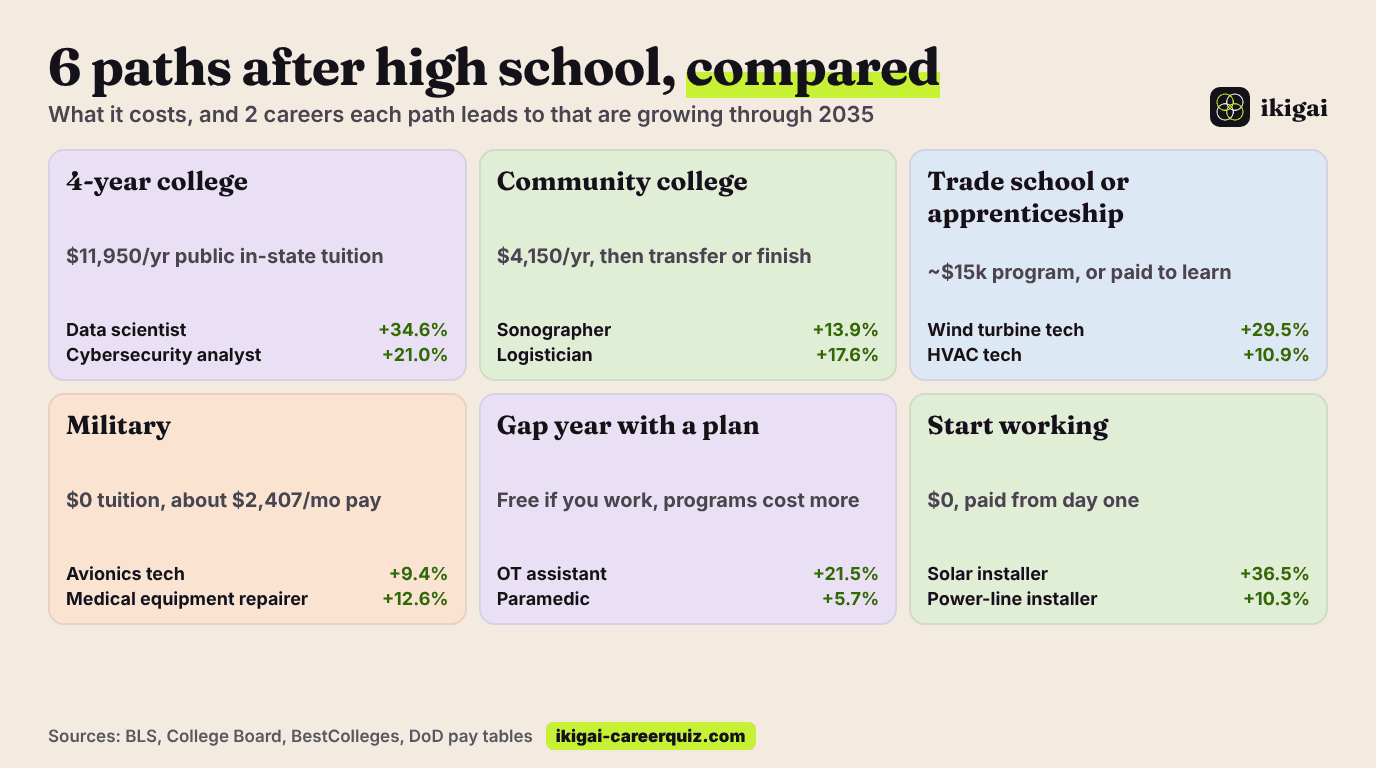
A 4-year public college runs $11,950 a year in tuition. The military pays an E-1 about $2,407 a month. Here are 6 paths after high school, what each costs, who each tends to fit, and 2 careers each one leads to that are growing through 2035.
Founder of Ikigai · Career data + personality science
Senior year has a way of turning every adult you meet into a career counselor. "So, where are you applying?" assumes there is one right answer, and that it involves a dorm.
There are at least six real paths after high school, and their price tags range from $45,000 a year in private college tuition to getting paid about $2,407 a month to train. None of them is the "smart" one or the "backup" one. They are different tools for different people.
So we put all six side by side: what each costs, who it tends to fit, and two careers each one can lead to that are projected to keep growing through 2035, from U.S. Bureau of Labor Statistics data.
Why 2035 is the year to look at
If you graduate in 2027, you will probably start full-time work somewhere between 2027 and 2032, depending on the path. That means the job market that matters to you is the one coming, not the one your older cousin walked into. Every career below is projected to grow between 2025 and 2035. We picked them to cover a range of interests, and we gave hands-on paths the same attention as degree paths, because the data says they deserve it.
The 6 paths at a glance
Fits if: You know roughly what you want to study, or the career you are curious about requires a bachelor's.
Fits if: You want college at a lower price, more time to decide, or a 2-year degree that leads straight to a job.
Fits if: You like seeing the result of your work, and you would rather learn by doing than by lecture.
Fits if: You want structure, training, a paycheck and education benefits, and you are OK with a multi-year commitment.
Fits if: You are burned out or unsure, and you will use the year to test a field instead of scrolling.
Fits if: You need income now, or you learn best on a real job site.
1. Four-year college
The default, and for some careers the only door. Average published tuition and fees at a public four-year college are $11,950 a year for in-state students in 2025-26, and $45,000 at private nonprofits (before grants, which bring the real price down for many families). That is tuition only, not housing or food.
Where it clearly pays off in our data: data scientists (+34.6%, median $120,230) and information security analysts (+21.0%, median $129,180). Both typically start with a bachelor's. If you are going this route, the major matters more than the logo, so read our guide on how to choose a college major before you commit. For the full cost-versus-payoff debate, see is college still worth it in 2026.
2. Community college, then transfer (or finish there)
The underrated move. Published tuition at public two-year colleges averages $4,150 a year, about a third of a public four-year school. You can take your general classes cheaply and transfer, or finish a 2-year degree that leads straight into a job.
One honest warning: the transfer route only works if you plan it. A national study from the Community College Research Center found that only about 16% of community college students earned a bachelor's within six years. About a third transferred, and slightly under half of those who transferred finished. Pick your target school early and confirm which credits it will take.
Two rising careers here: diagnostic medical sonographers (+13.9%, median $96,590), often an associate degree, and logisticians (+17.6%, median $82,320), a common destination for transfer students who finish a bachelor's in business or supply chain.
3. Trade school or apprenticeship
Trade programs averaged about $15,000 in tuition and fees, according to a BestColleges analysis of federal data (public programs ran cheaper, around $8,700). Registered apprenticeships flip the math: you are paid while you train. About 940,000 people were in registered apprenticeships in fiscal 2024, and the Department of Labor reported average earnings of about $80,000 after completion.
Rising careers: wind turbine service technicians (+29.5%, median $64,120) and HVAC mechanics and installers (+10.9%, median $61,010, with about 40,600 openings a year). For the high earners, see trade careers making six figures, and for the numbers head to head, trade school vs college.
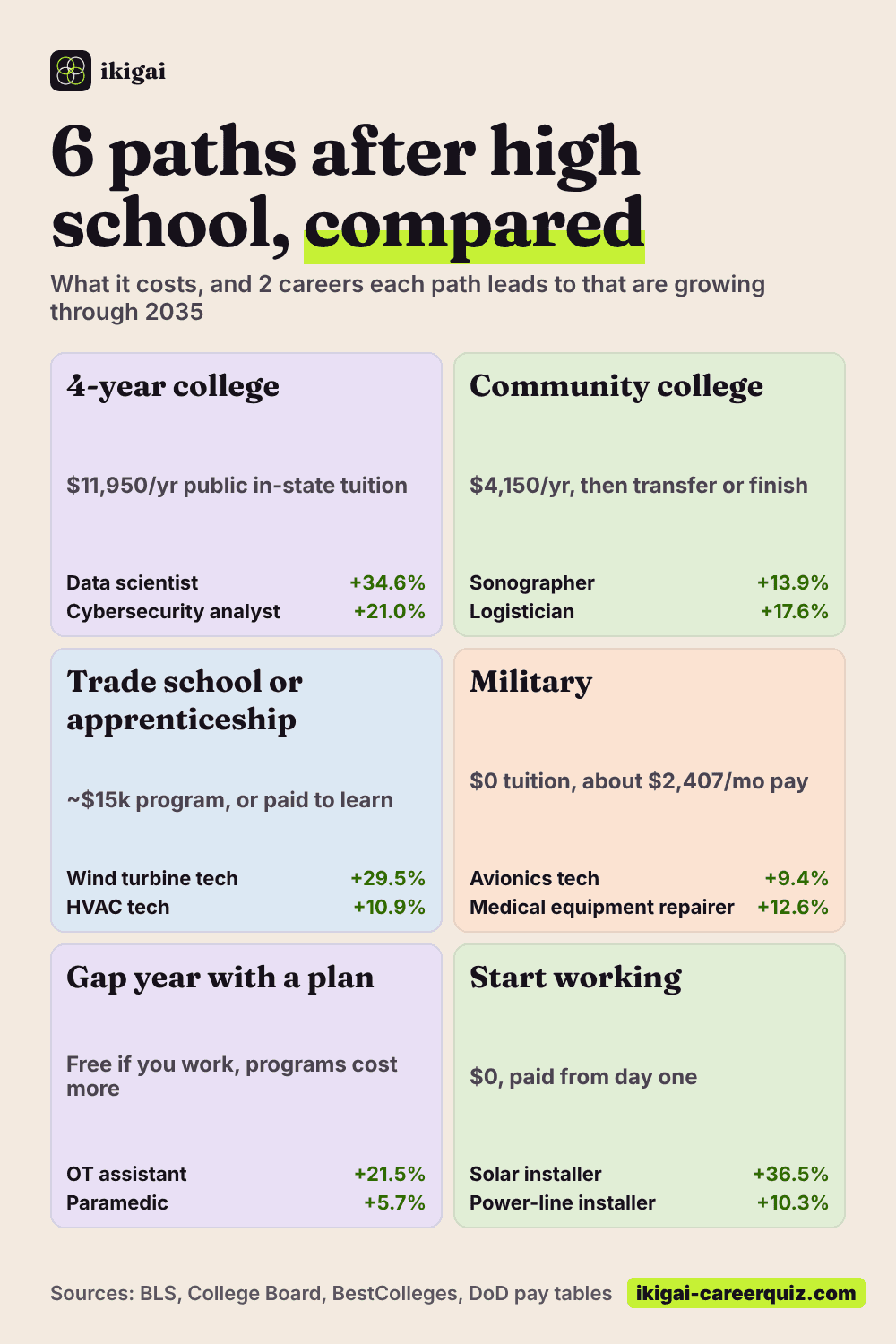
Save the chart
All 6 paths with cost and two rising careers each. Handy for the next time someone asks "so, what's the plan?"
Save to Pinterest4. Military
Tuition: zero. Pay: an E-1 with under two years of service earns about $2,407 a month in basic pay in 2026, after a 3.8% raise. The bigger prize comes later. After 36 months of active duty, the Post-9/11 GI Bill pays full net tuition and fees at public schools (and up to $29,920.95 a year at private schools for 2025-26).
The tradeoffs are real: a multi-year commitment, less control over where you live, and genuine risk. But many military roles are technical, and that training carries over. Two rising civilian careers it can lead to: avionics technicians (+9.4%, median $82,280) and medical equipment repairers (+12.6%, median $61,660).
5. Gap year with a plan
The key words are "with a plan." A gap year can cost nothing if you work, or a lot if you join a structured program. Either way, it works best when the year answers a question, like "do I actually like health care?"
Two careers a gap year can help you test-drive: take an EMT course and ride along, which is the usual first step toward paramedics (+5.7%, median $60,600), or work as an aide in a rehab clinic to see if occupational therapy assistants (+21.5%, median $72,300) feel like your people. If you come back knowing what you do not want, that counts too.
6. Start working
Cost: $0. Paycheck: immediate. Starting work is not "doing nothing," especially in fields where employers train you. Solar panel installers are the fastest-growing career on this page (+36.5%, median $53,140), and power-line installers (+10.3%, median $95,320) start with a paid apprenticeship. More options in jobs you can start at 18 and careers without a degree.
How to pick (without picking forever)
Paths combine. Lots of people work, then do community college. Or serve, then use the GI Bill. Or do an apprenticeship and earn a degree later, sometimes with an employer paying. Your first move is a first move, not a life sentence.
Start from the career, then work backward. "Which path?" is easier to answer once you know which careers you are curious about. A sonographer and a wind tech need very different routes.
Price the whole thing. Tuition is one line. Housing, lost wages and interest on loans are others. Run the numbers for the path, not just the first year.
And a caveat: these are national figures and 10-year projections. Your state, your local employers and what you actually enjoy matter more than any table. Treat this as a map of options, not a ranking of people.
Start with what fits you
Our quiz takes about 7 minutes, maps your interests, strengths and values (including how hands-on you like your work), asks what year you expect to start working, and ranks all 952 careers in our database by fit and projected growth by then. Each match shows the typical way in, so you can see which of these six paths leads there. More on how it works for teens in our career quiz for high school students guide.
Take the quiz and see which rising careers fit you, and which path gets you there. Parents, here is how Ikigai helps your teen explore careers.
Sources: Published tuition and fees for 2025-26 ($4,150 public two-year in-district; $11,950 public four-year in-state; $45,000 private nonprofit four-year) from College Board, Trends in College Pricing and Student Aid 2025 (November 2025). Community college transfer outcomes (about one-third transfer, 16% earn a bachelor's within six years, 48% of transfers complete) from the Community College Research Center, Aspen Institute and National Student Clearinghouse, "Tracking Transfer" (2024). Trade school tuition and fees (about $15,000 average; about $8,700 at public schools) from BestColleges, "How Much Does Trade School Cost?", using IPEDS data. Registered apprentices (about 940,000 in FY2024) and average earnings after completion (about $80,000 in FY2023, as reported by the Department of Labor) from GAO (May 2025). 2026 military basic pay (E-1 under two years, about $2,407 a month; 3.8% raise) from Military.com (December 2025). Post-9/11 GI Bill eligibility (36 months of active duty for the full benefit) and 2025-26 private school cap from the U.S. Department of Veterans Affairs. Career growth (2025 to 2035), annual openings and median pay from BLS Employment Projections and OEWS (May 2025), via scripts/blog-what-to-do-after-high-school.ts. Entry paths are typical routes, not requirements.
Liked this article?
Get weekly career insights backed by real labor market data. Free, no spam.
Keep reading
Find your Future-Fit Career
7-minute personality quiz. 952 careers. Real BLS data. No account needed.
Take the quiz →