
The Best Careers for High School Students to Aim For (Ranked by 2035 Growth)
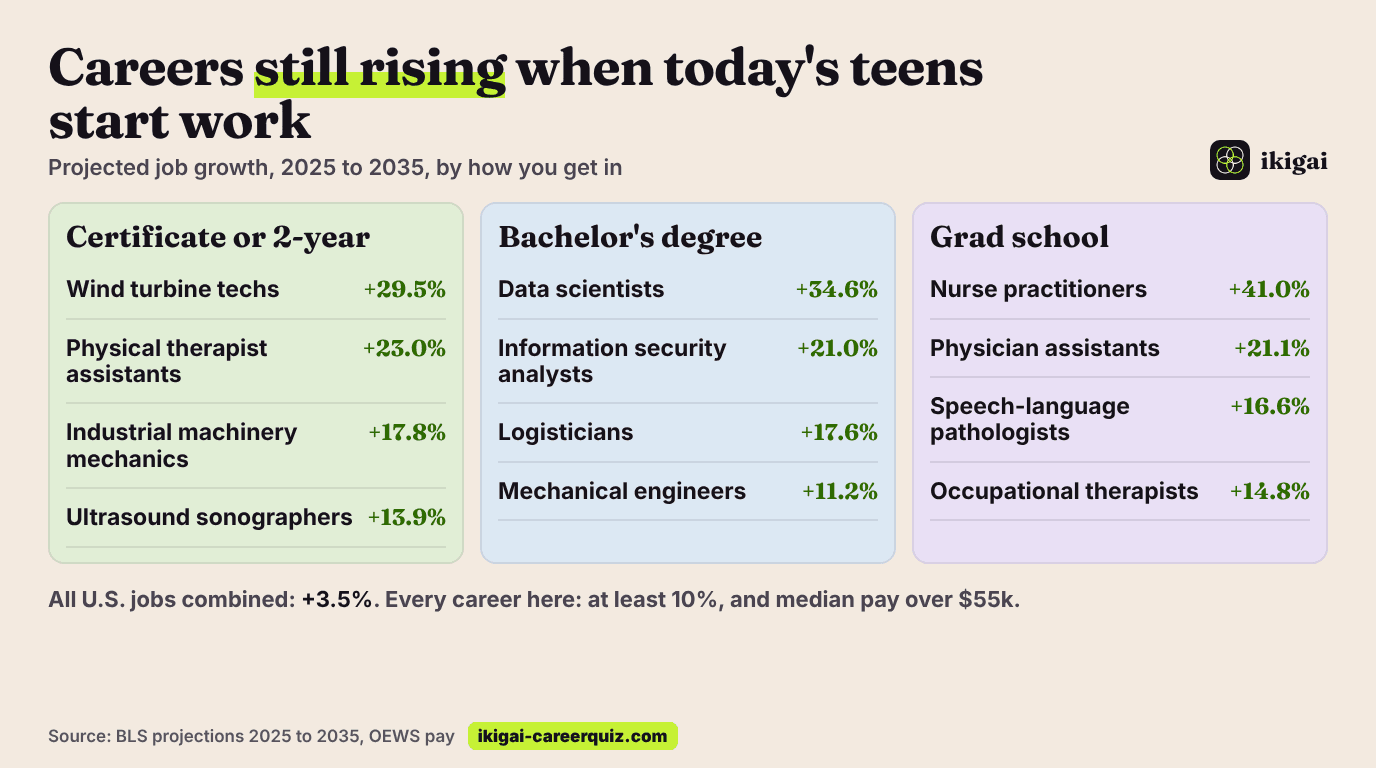
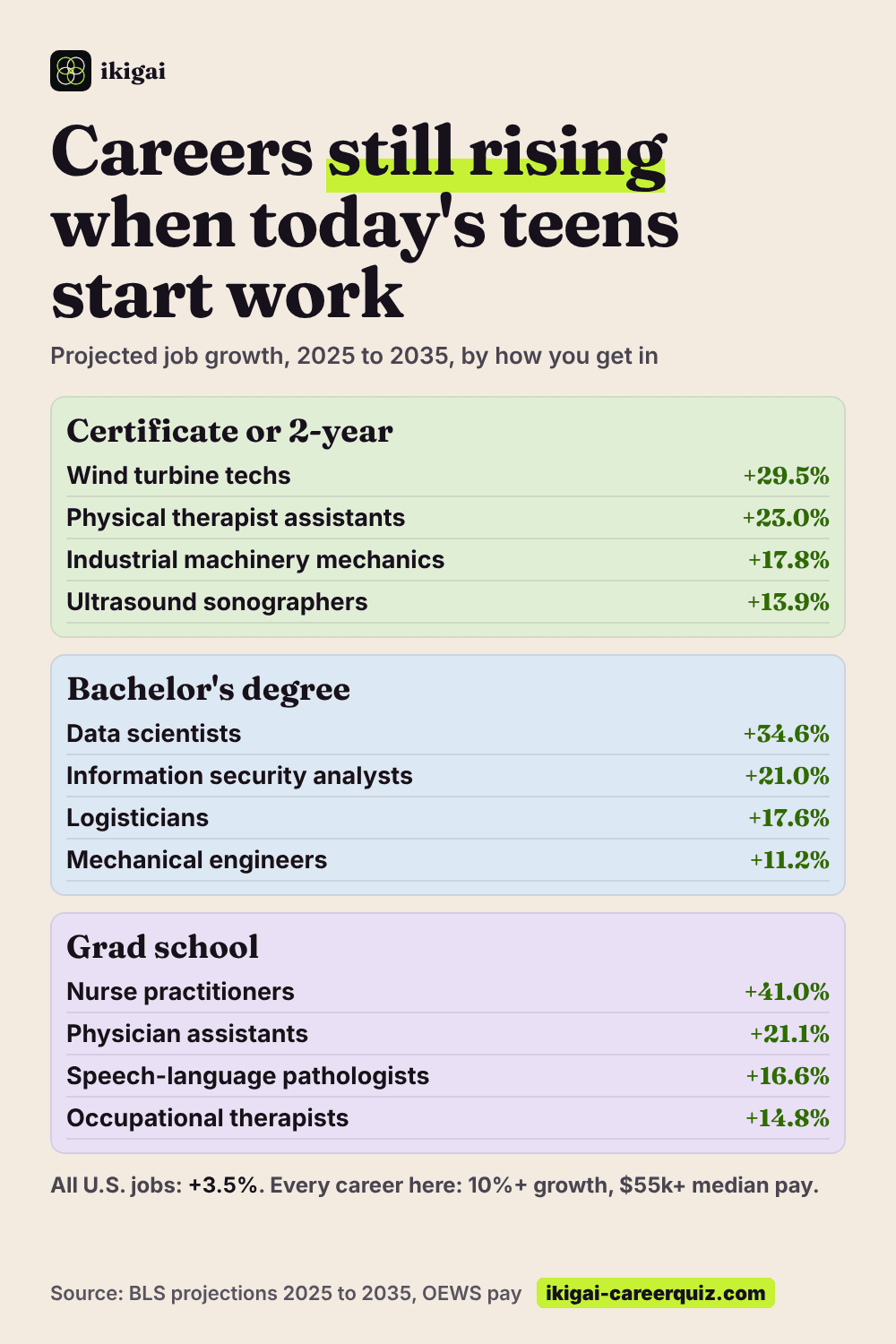
Most "best careers" lists rank today's job market. A 16 year old starts full-time work around 2030. Here are 18 careers projected to grow at least 10% by 2035 and pay a $55k+ median, grouped by how you get in.
Founder of Ikigai · Career data + personality science
Here is the problem with almost every "best careers" list: it ranks the job market of today. But if you are 16 right now, you probably will not start full-time work until somewhere between 2028 and 2034. The job market you are actually aiming at has not happened yet.
And teens are, understandably, a little lost about it. In the OECD's look at career plans of 15 year olds across dozens of countries, 39% could not name a career they expected to have, roughly double the share from less than a decade earlier. Among those who could, about half of girls and 44% of boys picked from the same 10 popular jobs.
So let's do it differently. We took every occupation in our database, which uses the U.S. Bureau of Labor Statistics projections for 2025 to 2035, and kept only the careers that clear three bars:
- Projected to grow at least 10% by 2035 (all U.S. jobs combined: 3.5%)
- A median salary of at least $55,000
- At least 10,000 people doing the job today, so it is a real field and not a rounding error
Only about 1 in 12 occupations in our data is projected to grow 10% or more. Add the pay and size filters and 55 careers survive. Below are 18 of the strongest, grouped by how you get in, because that is the decision you actually make in high school.
Save the chart
Twelve rising careers, three ways in. Handy for the next time someone at dinner asks "so what do you want to do?"
Save to PinterestWhy rank by 2035 and not by today?
Because a career's growth decides how much leverage you have when you show up. In a growing field, employers compete for new people: more openings, faster raises, more room to move. In a shrinking one, you compete with everyone already in it for fewer seats. Same effort, very different tailwind.
The timing is also why your entry path matters so much. A certificate gets you into the workforce around 2028 or 2029. Grad school puts you there in the early 2030s. The 2035 projections line up with the years you would actually be job hunting, which is the whole point.
Certificate, apprenticeship or 2-year degree
Working full time around age 19 to 21 if you start right after high school.
Bachelor's degree
Working full time around age 22 if you start right after high school.
Grad school
Working full time around age 24 to 26 if you start right after high school.
What jumps out
The fastest route is not the weakest one. Two of the six careers in the first group (sonographers at $96,590 and power-line installers at $95,320) have higher median pay than logisticians, and you can be working years earlier with far less debt. Power-line work usually starts as a paid apprenticeship, so you earn while you train. If building, fixing or climbing sounds better than a lecture hall, our guide to skilled trades that pay well goes deeper, and so does our list of careers without a degree.
Health care is everywhere. It shows up in all three groups, from two-year therapy assistants to nurse practitioners, the single fastest-growing career on this list at 41%. An aging population needs hands-on care, and that is hard to automate. If you like helping people but not the idea of blood, look at speech-language pathology, occupational therapy or counseling.
Tech is rising, but it is not the only rising thing. Data scientists (+34.6%) and information security analysts (+21.0%) are on the list. So are wind turbine technicians (+29.5%), who never touch a spreadsheet if they can help it. Wind tech is a small field, around 11,800 jobs, so growth there means hundreds of new seats a year, not tens of thousands. Worth knowing before you fall in love with a percentage.
Pay is not the same as fit. Mental health counselors sit at the bottom of the pay range here ($59,350 median) and still made the cut because demand is climbing fast. For the right person, that tradeoff is easy. For someone else, it is a dealbreaker. Both are fine answers.
How to use this list (without letting it boss you around)
- Circle anything that makes you curious. Not "could I do this forever," just "I would read about this." Click through to the career pages for tasks and pay.
- Notice which column you keep circling in. That tells you more about your next two years than any single job does. If it is the bachelor's column, our guide on how to choose a college major is the natural next read.
- Test one cheaply. Shadow for a day, take a dual-enrollment class, join a robotics team, volunteer at a clinic. Cheap tests beat long debates.
- Check the fit, not just the trend. A rising career you dread is still a career you dread.
What this list cannot tell you
These are national, 10-year projections. They cannot see your town, a surprise technology shift or a policy change, and they get fuzzier the further out you go. Treat them as a tailwind check, not a prediction of where you will end up. The training paths are typical routes, not rules; requirements vary by state and employer.
And the biggest thing a ranking cannot see is you. Plenty of great careers did not make this list because they grow at 5% instead of 10%. If one of those fits you perfectly, that can matter more than a few points of growth.
Find the rising careers that fit you
This list is the same for every reader. Your version should not be. Our quiz takes about 7 minutes, maps your interests, strengths and values, asks what year you expect to start working, and ranks all 952 careers in our database by how well they fit you and how they are projected to grow by then. More on how it works for teens in our career quiz for high school students guide.
Take the quiz and see your own top matches. Parents, there is a page for you too: how Ikigai helps your teen explore careers.
Sources: Teen career uncertainty (39% of 15 year olds unclear, roughly double from less than a decade earlier) and concentration in 10 popular jobs (about half of girls, 44% of boys) from the OECD report "The State of Global Teenage Career Preparation" (May 2025, PISA 2022 data), as reported by DevelopmentAid (May 21, 2025) and The 74 (July 8, 2025). All-jobs growth (3.5%, 2025 to 2035) from BLS, The Economics Daily (September 21, 2026). Career growth (2025 to 2035), employment and median pay from U.S. Bureau of Labor Statistics Employment Projections and OEWS (May 2025), via scripts/blog-best-careers-for-high-school-students.ts. Entry paths are grouped by O*NET Job Zone and describe typical routes, not requirements.
Liked this article?
Get weekly career insights backed by real labor market data. Free, no spam.
Keep reading
Find your Future-Fit Career
7-minute personality quiz. 952 careers. Real BLS data. No account needed.
Take the quiz →